
For patients
Urinary catheter and an enlarged prostate: could HoLEP help?
Dr. Fernando Gómez Sancha · ICUA
Dr. Fernando Gómez Sancha · YouTube
Language: English. Editorial classification in the patient catalog.
Playback connects to YouTube. Your search query is not sent to the player.
About this video
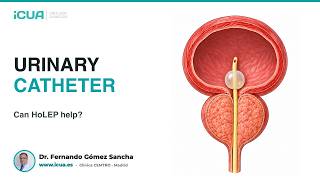
Do you need a urinary catheter because your prostate is preventing you from passing urine? I’m Dr Fernando Gómez Sancha. In this video, I explain why some patients need a catheter for months or years and how holmium laser enucleation of the prostate, known as HoLEP, may help.
We discuss urinary retention, large prostates, age, general health and recovery after surgery. I also explain an important limitation: if the bladder has lost its ability to contract after very prolonged retention, the results may be partial.
Each patient needs an individual assessment by a urologist experienced in laser enucleation.
Documented details and sources
Only details explicitly stated in the sources. Missing information does not mean it did not occur.
No clinical case details have been extracted for this video.
Original title and description on YouTubeSource checked: 2026-10-04.
Video moments
- Why do you end up with a permanent catheter?
- Catheter because of the prostate: is there a solution?
- Too old or on blood thinners for surgery?
- Urinating for the first time after years with a catheter
- With a catheter: why waiting is a bad idea
- Urinary catheter and an enlarged prostate: could HoLEP help? · 0:00
- Urinary catheter and an enlarged prostate: could HoLEP help? · 0:41
- Urinary catheter and an enlarged prostate: could HoLEP help? · 1:25
- Urinary catheter and an enlarged prostate: could HoLEP help? · 2:08
- Urinary catheter and an enlarged prostate: could HoLEP help? · 2:50
- Urinary catheter and an enlarged prostate: could HoLEP help? · 3:28
Available transcript · English
Source: subtitles embedded in the published video.
They may contain transcription or translation errors; check the explanation in the video.
- Have you spent months or even years with a urinary catheter because your prostate won't let you urinate on your own? Have you been told that at your age nothing can be done or that your prostate is just too large to be operated on?
- Today I want to tell you something. That is probably not true. I am Doctor Gomez Sancha, uh, I have spent thirty-two years in Urology and have operated on over ten thousand prostate patients with lasers.
- And a significant portion of these patients arrived at my clinic with a permanent catheter. They are, without exaggeration, the cases that give me the most satisfaction as a surgeon.
- Why does a patient end up with a permanent catheter? The most frequent cause is acute or chronic urinary retention. The prostate has grown so much that it completely compresses the urethra.
- You cannot urinate. If it is acute retention, you go to A&E, they put in a catheter and that is where the ordeal begins. They tell you to try removing it in a few days with medication.
- The medication does not work, they put it back in and in the end you finish with a catheter that is changed every month or for months, sometimes for years. And this affects the quality of life in a brutal way.
- It produces recurrent infections, continuous discomfort, dependency, a loss of self-esteem, and probably a depressive state. I have had patients who stopped leaving the house, who stopped travelling, who stopped having a social life because of a catheter.
- Can it be resolved? Well, almost always, yes. With the right technique, the vast majority of these patients can go back to urinating on their own. Holmium laser enucleation is precisely the ideal technique for these cases.
- I will explain why. First, patients, uh, with urinary retention often have large prostates of one hundred, one hundred and fifty, two hundred grams or more. With transurethral resection, these prostates are not managed well.
- Open surgery carries a lot of risk for patients of, of an advanced age. However, enucleation allows for endoscopic surgery with low risk, for prostates with no size limit. Secondly, many of these patients take anticoagulant medication for their heart pathology.
- Holmium laser enucleation has a very low risk of bleeding. We operate on anticoagulated patients on a regular basis. In third place, age. I have operated on patients of eighty-five and ninety years with success.
- What matters is not the age, but the general state of health and the ability to tolerate spinal anaesthesia, which is gentle and is not a general anaesthetic. What happens after the surgery?
- In most cases we remove the catheter the day after the operation and the patient urinates on their own after months or years with a catheter. I am going to tell you something that moves me every time I experience it.
- When a patient who had a permanent catheter for a year and a half urinates for the first time after the operation, the expression on their face, the sense of relief, the new perspective on life, right?
- It's one of those things that makes doing this job worthwhile. I've seen eighty-year-old men cry with joy and hug me and say, "Thank you, doctor." No, not all cases are the same. Some patients with very prolonged urinary retention have bladder damage, they've lost contractility.
- In these cases, the results can be partial. That's why it's important not to wait too long. The sooner the surgery, the better the bladder works. If you have a permanent catheter or a relative does, don't just accept it.
- Have a urologist experienced in laser enucleation assess the case. It can change your life, literally. Subscribe for more information.