


A note from the surgeon
Why I wrote this guide
Every week I hear from men in many countries who have already been told they need an operation, but nobody has explained why that one and not another, what they stand to gain or lose, or what the first days after surgery are really like when home is a long way from the hospital.
I have been operating on prostates with lasers for twenty-three years, enucleating them for twenty, and teaching other surgeons for almost as long. This guide is what I tell every patient in my consulting room: what HoLEP is, what en bloc and early apical release mean, what our own published results show and — this matters to me as much as the rest — what I cannot promise you.
Throughout the text you will see three kinds of data, and I always keep them apart: what the general evidence on HoLEP supports, what we know specifically about the en bloc technique, and what are results from our own centre, which will not necessarily be repeated anywhere else. When I give a figure, I tell you where it comes from.
If one thing should stay with you: the name of an operation is never enough. The result depends on the right diagnosis, careful technique, an experienced team and follow-up that does not stop at the hospital door. And one more thing: the numbers you are about to read belong to groups of patients; none of them describes your case yet.
Dr Fernando Gómez Sancha · Urologist, Madrid
If you have an urgent symptom right now
You cannot pass urine, you are bleeding heavily or passing clots, you have a fever, chest pain, shortness of breath, a swollen leg or confusion: go to your local emergency department. Do not e-mail me — go to a hospital.
Start here
In one sentence

HoLEP removes the prostate tissue that is blocking your urinary channel, working through the urethra itself, with no cut in the abdomen, and it works for small prostates as well as for many of the really large ones.
The en bloc variant is simply a more refined way of doing that removal: we follow the anatomical plane around the adenoma as if it were a single piece, and we free the area next to the sphincter early, to look after your continence as well as we can.
Put another way
HoLEP takes the blockage out through the natural passage; en bloc describes how the surgeon travels that passage. Neither replaces the experience of the person holding the laser.
Is this guide for you?
HoLEP may be the right operation for you if:
- medication no longer controls your symptoms, or you tolerate it badly;
- you keep going into urinary retention, or you depend on a catheter;
- you carry recurring infections, bladder stones or bleeding caused by the obstruction;
- your bladder or kidneys are starting to suffer;
- you have a large prostate and want a treatment that genuinely removes tissue;
- the obstruction has come back after another prostate operation.
Prostate size on its own decides nothing. How your bladder is working, your anatomy, your general health, the medication you take, previous surgery and what you prioritise all count too.
When I usually park HoLEP as the first option
If there is an active untreated urinary infection, or an uncorrected clotting disorder, we wait. If the urethra is very narrow, that sometimes has to be sorted out first by another route. If the assessment points to a prostate cancer that needs cancer surgery, starting with an operation designed for benign obstruction may not be the right thing. These are decisions we make in the consulting room, not something you should diagnose yourself at home.
Understanding the problem
How an enlarged prostate affects you, and what HoLEP does
What an enlarged prostate does
The prostate wraps around the first stretch of the urethra. When the inner tissue grows, it squeezes that channel. Hence the weak stream, the straining to get started, the incomplete emptying, the urgency, the trips to the bathroom at night and, in the worst cases, complete retention.
Before deciding anything we usually ask for urine and blood tests and your PSA (prostate-specific antigen) history, measure your flow and what is left in the bladder after you void, do an ultrasound or MRI and a cystoscopy, and sometimes a urodynamic study. All of that is to confirm that the problem really is prostatic obstruction. Surgery can remove that obstruction; what it cannot do is promise that any other bladder complaint you already had will disappear.
What happens in the operating theatre
We go in with an endoscope through the urethra. With a holmium laser, the surgeon separates the inner tissue that has grown — the adenoma — from the capsule that surrounds it, a little like peeling an orange from the inside without damaging the skin. The freed adenoma drops into the bladder, where we break it up with a morcellator and take it out, again through the urethra. Then it all goes to pathology, and this matters: sometimes something turns up that we were not expecting.
This is different from simply opening a wider channel by cutting or vaporising part of the tissue. Here we aim to take out the whole adenoma, following its natural plane.
One thing I always make clear in clinic
HoLEP does not treat prostate cancer. Prostate tissue remains, the prostatic capsule; PSA does not drop to zero, and you may still need cancer screening later on.
Figure 1. What HoLEP does, in three pictures
Side view of the prostate, with the bladder on the left and the urethra leaving to the right.
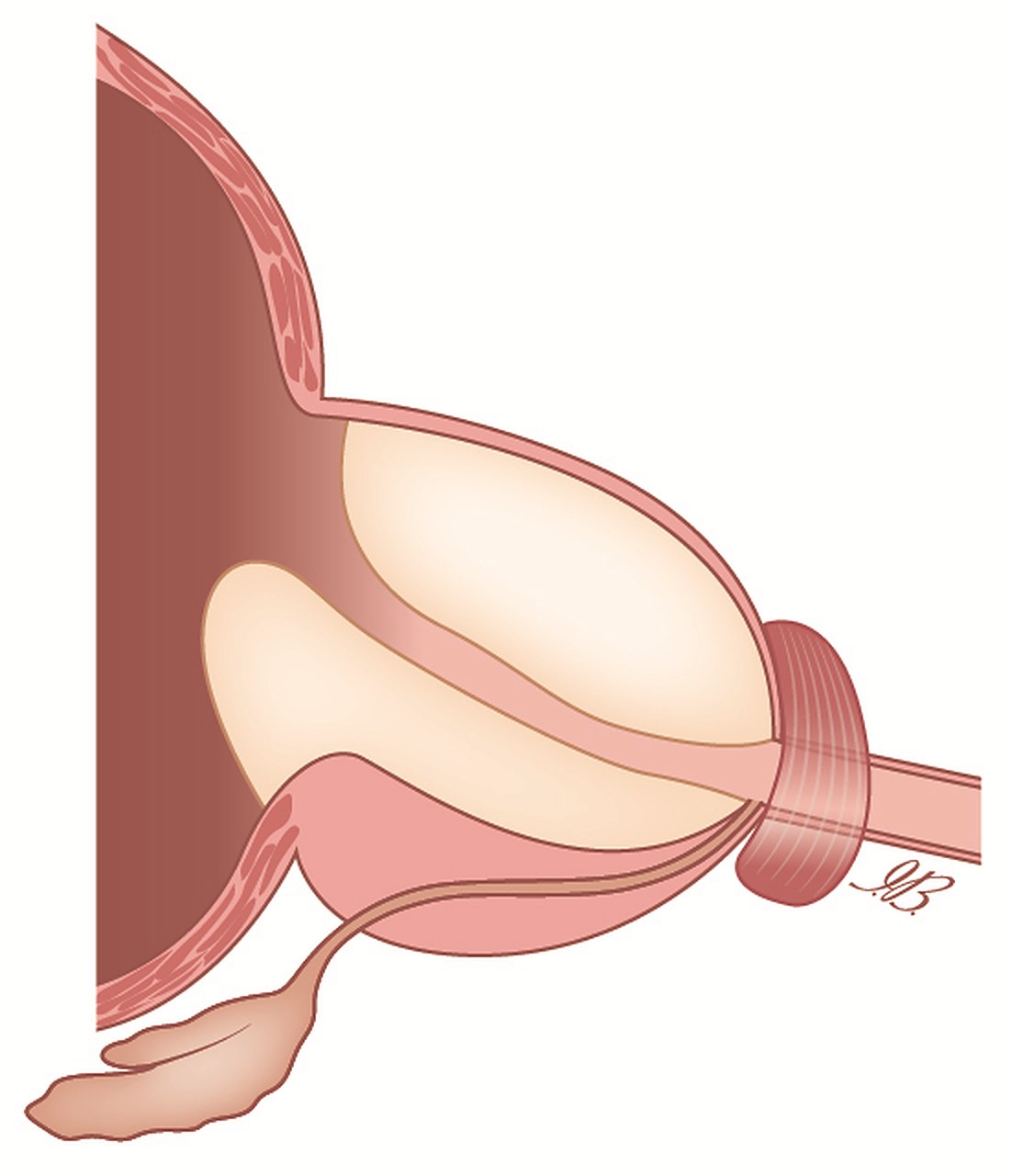
ABefore: the adenoma inside the prostateThe pale part is the adenoma, the tissue that has grown around the urethra and squashes it. The pink part wrapped around it is the capsule, the prostate that stays. The ring on the right is the sphincter, the muscle of continence. 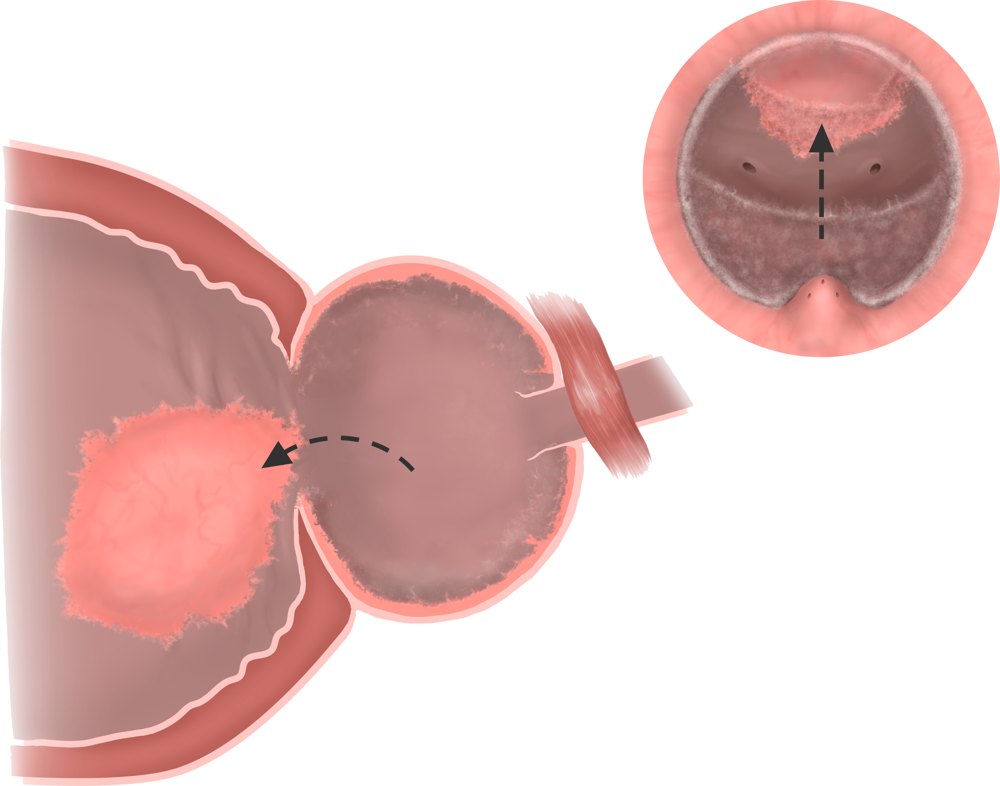
BEnucleation: the adenoma, whole, into the bladderFollowing the plane that separates the adenoma from the capsule, I peel it off as a single piece and push it into the bladder. In the detail, the empty cavity seen from the urethra, with the adenoma showing through the neck. The capsule is left smooth and in place; the sphincter, untouched. 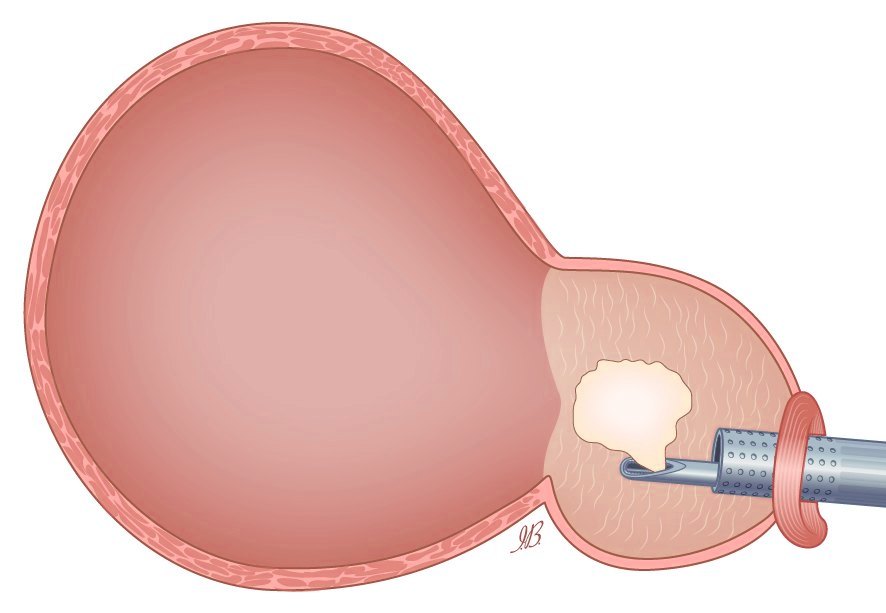
CMorcellation: broken up and removedOnce inside the bladder, an instrument called a morcellator chops the adenoma up and sucks it out through the same channel we came in by. There is no cut in the abdomen. The fragments go to the pathologist.
Illustrations © Fernando Gómez Sancha. All rights reserved.
If you would rather watch it explained, my playlist “The Prostate Explained by Dr Gómez Sancha” (YouTube, 11 videos) goes through it calmly and without surgical footage.
Interactive anatomy
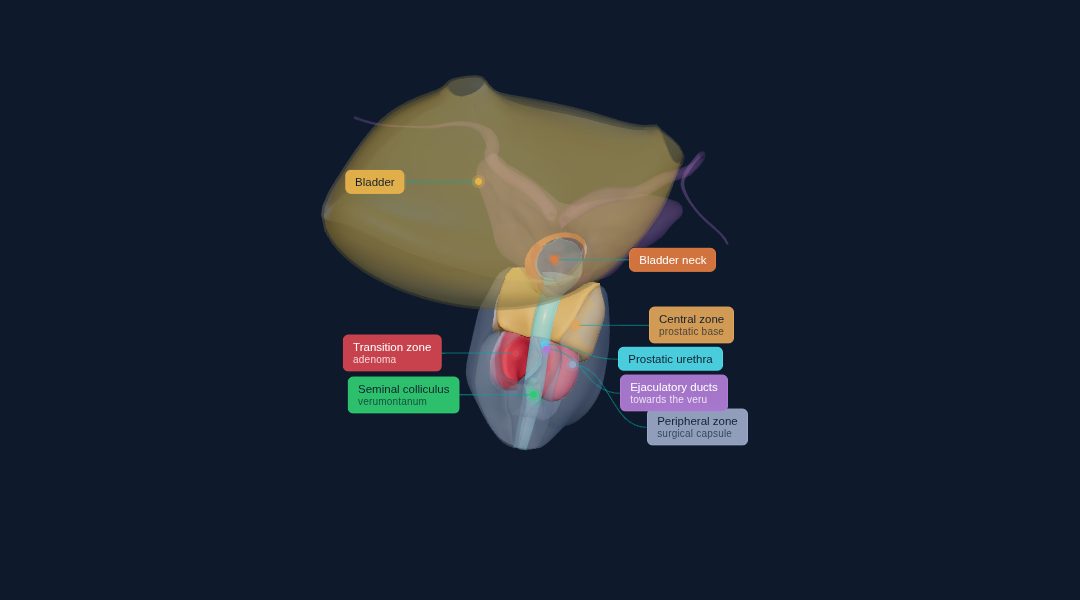
Explore the prostate and bladder in 3D
The diagrams above simplify a great deal. If you want to see where everything really sits, this three-dimensional model is built from the reference anatomical atlas of the Visible Human of the United States National Library of Medicine. You can rotate it, switch each structure on and off (transition zone, peripheral zone, urethra, seminal colliculus…) and drag the growth slider to watch the transition zone turn into an adenoma and narrow the urethra. The adenoma you see growing is exactly what HoLEP enucleates; the capsule and the peripheral zone are what stays.
Technique
“En bloc”, and why I am obsessed with the apex
For years, classic HoLEP was taught by dividing the adenoma into two or three separate lobes. The en bloc technique treats it as one continuous anatomical piece, from start to finish. To be clear: that does not mean the prostate leaves the body whole — it still has to be morcellated to come out — it is the way we enucleate that we describe like this.
The apex is the point where the adenoma meets the external urinary sphincter, the muscle that keeps you dry. With early apical release we try to define and free that delicate area at the very beginning of the operation, before the rest of the adenoma pulls on it, looking after the thin mucosa that lines the sphincter.
Figure 2. For comparison: how a classic three-lobe enucleation used to end
The view from the urethra at the end of the operation, the way HoLEP was taught for years. It is the same operation and the same tissue comes out; what changes is the route.
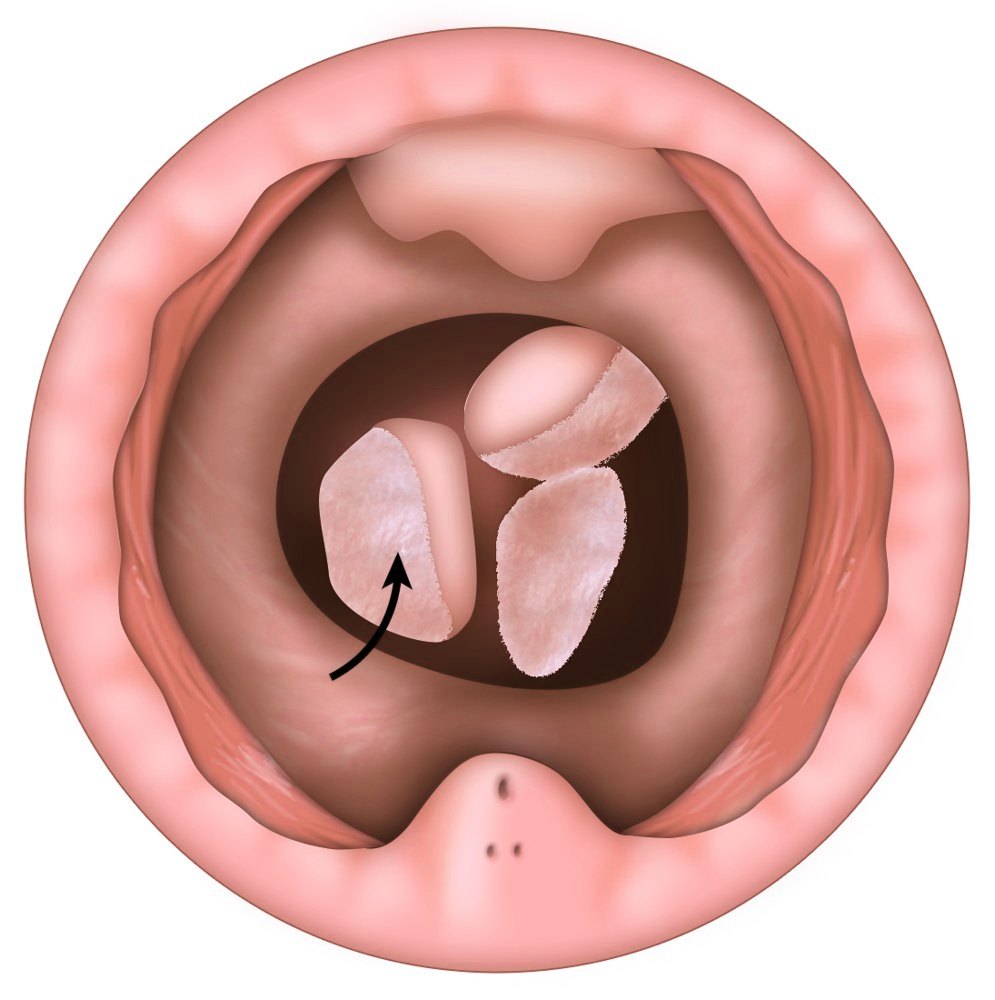
Three pieces in the bladder, and an edge I do not likeThe adenoma has come out as three lobes, which are now in the bladder. Look at the lower edge, next to the colliculus: the mucosa that covered the sphincter has been left torn and ragged, because the sphincter was dissected mechanically, with a circumferential sweep of the instrument that tore that mucosa away as each lobe was freed. That edge is exactly what early apical release protects: in the en bloc technique I define and free it at the start, with the laser and without pulling, before the adenoma can drag on it, and the adenoma then comes out whole, as in figure 1. Today many surgeons have adopted this same philosophy — release the apex early and protect the sphincter mucosa — while still enucleating in two or three lobes (sometimes taking a lateral lobe and the median lobe together), and they get very good results.
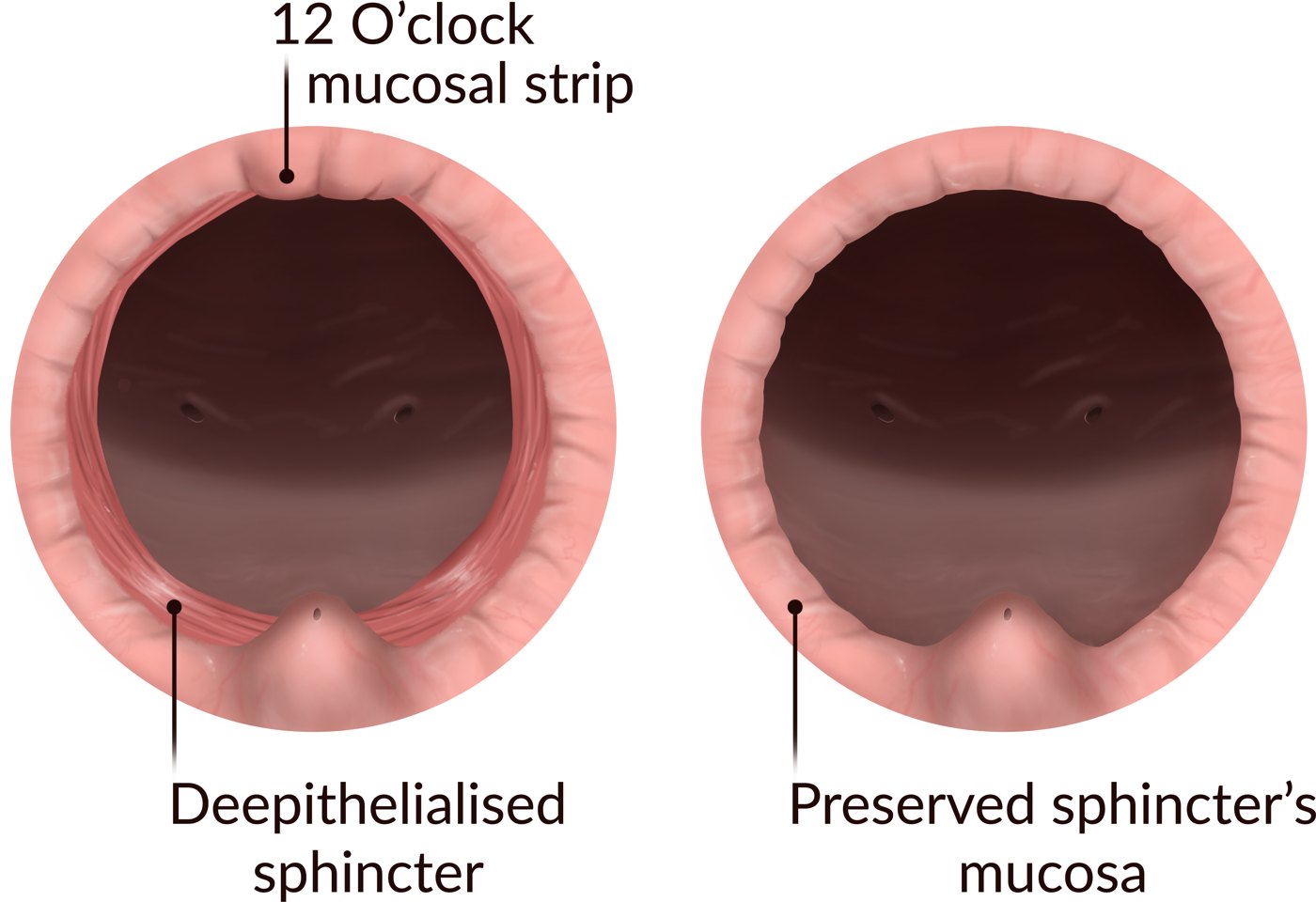
Illustrations © Fernando Gómez Sancha. All rights reserved.
The published evidence supports en bloc HoLEP as effective and efficient in trained hands. What it does not show — and I am not going to sell it to you as if it did — is that the label “en bloc” on its own prevents incontinence. What really makes the difference is a well-executed apical dissection, care of the mucosa, and the hands doing the operating.
Outcomes
What can I realistically expect?
We are after a stronger stream, better emptying, less straining, and an obstruction that does not come back. Urgency and night-time trips to the bathroom sometimes take longer to improve, especially if the bladder has been obstructed for a long time.
What we have published about our own results
Remember: group results, not an individual promise.
These numbers support en bloc HoLEP in experienced hands, large prostates included. What no statistic can do is predict how you, specifically, will recover.
Choosing
How does it compare with other options?
There is no single best operation for everyone. The right choice depends on your anatomy, the size of the prostate, your health, your priorities, the expertise available where you are, and which trade-offs you are prepared to accept.
Scroll the table sideways to see every column →
| Option | What it does | Why choose it | The real trade-off |
|---|---|---|---|
| Medication | Relaxes the prostate or slows its growth | Avoids or delays surgery | Does not remove the obstruction; the effect varies from person to person |
| Water vapour (Rezūm®) · urethral lift (Urolift) | Treats specific tissue, minimally invasive | May better preserve ejaculation in selected anatomy | Removes less tissue; not suitable for every size |
| TURP | Cuts a channel through the obstructing tissue | Well-established technique, especially for small or medium glands | Not an anatomical enucleation |
| Aquablation® | Removes tissue with a robot-guided waterjet | Good symptom relief; may preserve ejaculation in selected cases | Bleeding, anatomy and retreatment need to be considered |
| HoLEP | Enucleates the whole adenoma, following its plane | Works for almost any size, without opening the abdomen, and the tissue goes to pathology | Forward ejaculation is lost; the surgeon's experience weighs heavily |
| Simple prostatectomy | Removes the adenoma through an abdominal or robotic approach | A good option for very large glands, or if the abdomen has to be operated on for another reason | More invasive, more days with a catheter and in hospital |
On very large prostates
Simple prostatectomy, open or robotic, remains a solid option for enormous glands. A 2025 propensity-matched study of prostates of 80 g or more found similar functional results for en bloc HoLEP and robotic prostatectomy at three months, with fewer catheter and hospital days for HoLEP. It was not a randomised trial.8
Our own data include 110 prostates of 120 g or more operated on with en bloc HoLEP, with good functional results.9
Do not stop at “Which technology do you have?” Ask why that option is the best one for your anatomy, your bladder and your priorities, and ask to see their audited results. The brand of the laser matters far less than the hand that holds it.
Take them to any consultation
Ten questions I recommend asking your surgeon
- How many HoLEPs do you do a year?
- How many with this exact technique?
- Do you regularly operate on prostates of my size and on patients with my history?
- What are your own rates of transfusion, readmission, persistent incontinence, stricture and retreatment?
- How do you measure continence?
- What is your usual catheter and discharge routine, and what can make it longer?
- What happens if I cannot pass urine once the catheter is out?
- Who answers if I have an urgent question after discharge?
- Is all the removed tissue sent to pathology?
- What result is realistic for my bladder in particular, not just for the size of my prostate?
Take them along too if you are going to ask for a second opinion closer to home.
Let's be straight
The real trade-offs
Ejaculation and fertility
With a standard HoLEP, most men lose forward ejaculation (it becomes retrograde). Orgasm and erections are normally unaffected, but fertility is. If this matters to you — to have children, or for any other reason — tell me before we decide on treatment, not after.
Leakage at the start
It is normal to have some stress leakage when you cough or move, or some urgency leakage, in the first days after the catheter comes out. Most of it improves with healing and pelvic-floor exercises. But I will be honest: some incontinence can remain, although it is uncommon in experienced hands.
Other risks
Bleeding, infection, temporary retention, scarring in the urethra or the bladder neck, complications of anaesthesia, or needing another procedure. Now and then, pathology finds a prostate cancer we did not suspect.
If you take anticoagulants or antiplatelet drugs
Never stop them on your own. That is a decision we make together with whoever prescribed them and the surgical team, with a plan made for you.
Orientation, not a schedule you have to keep
How recovery usually goes
Surgery under general or spinal anaesthesia; the catheter is placed.
No cut in the abdomen; the tissue goes to pathology.
Irrigation if needed, walking, drinking, and checking how the catheter is doing.
In our 137-patient publication, mean catheter time and stay were 1.2 days. That is a group average: the most likely thing is that yours will be similar, but it is not a promise.2
The great majority are urinating without a catheter; others need a little longer.
Discharge depends on bleeding, on there being no infection, on how you urinate and on your general recovery.
Variable stream, frequency, urgency, tiredness, perhaps some blood.
No heavy exertion; follow what we tell you about drinking, work, sex and when to genuinely worry.
Control keeps settling.
In our series, stress leakage fell from 5.8% at one month to 1.5% at three.2
Review of how everything is working, PSA plan, long-term follow-up.
If leakage, infection, poor flow or bleeding persist, they need reviewing: our series recorded 0.7% stress incontinence at six months.2
Your surgeon's instructions always come before any generic schedule, including this one.
Straight answers
Questions I am always asked
Will I be dry from day one?
No honest surgeon can promise you that. Many patients get there quickly; others have temporary stress or urgency leakage. In series from experienced surgeons, something permanent is rare, but it does happen.
How long will I have the catheter?
In our series of 137 patients, 1.2 days on average.2 You may need it for less or for longer, depending on bleeding, how your bladder works and whether you urinate well once it is out.
When can I fly home?
There is no fixed day for everyone. We look at bleeding, how you are urinating, whether you still have a catheter, the risk of infection, your general health and how long the flight is. My advice, if you are coming from away: keep your travel plans flexible until we confirm.
When can I go back to work, sport and sex?
Light activities usually come back before heavy lifting, intense sport or sex. We give you your own dates at discharge.
Will I need pads?
Some men use them for a while for mild leakage; others are dry from the start. If leakage stays or gets worse, it needs reviewing, and pelvic-floor rehabilitation usually helps.
Does it hurt?
There is no abdominal wound, but the catheter can be uncomfortable, and there is sometimes burning, urgency or bladder spasms. If the pain is severe, getting worse, or comes with a fever, it needs assessing.
What about blood thinners?
Keep taking them until you have a written plan. When to stop them, if at all, and when to restart is something we agree with the doctor who prescribed them, depending on why you take them and your risk of bleeding or of clots.
Will I stop getting up at night to urinate?
Not always completely. Relieving the obstruction helps, but getting up at night can also be down to an overactive bladder, poor sleep, how much you drink, diabetes, heart problems or other causes.
Will my erections change?
HoLEP is not designed to treat erectile dysfunction, and most men keep their function. What usually does change is ejaculation, which becomes retrograde.
Can the prostate grow back?
The outer tissue remains, but we remove most of the obstructing adenoma. It is a durable treatment, although no operation comes with a lifelong guarantee. In the US Epic Cosmos registry, surgical retreatment at five years was 4.4% for HoLEP/ThuLEP combined and 7.1% for TURP. This is an unadjusted observational comparison. The paper on our series of 754 patients does not provide a comparable five-year retreatment rate for recurrent obstruction.11
Does a very large prostate mean open surgery?
Not necessarily. We have published 110 cases of 120 g or more operated on with en bloc HoLEP, with good functional results.9 Your anatomy, your bladder, previous surgery and the expertise available still count.
Why size matters less than it seems: the adenoma grows in volume, but the surface that has to be dissected grows much more slowly. See it in this interactive 3D model ↗
Is en bloc always better than classic HoLEP?
No. It can be more efficient in the operating theatre, but continence results vary between studies. I would take a well-done lobe-by-lobe HoLEP over a badly done en bloc any day.
What does it cost?
We do not publish a fixed price because the total depends on the assessment, the operation and how long you are in hospital. If you send us your records, we send you a written quotation, with what it includes and what it does not, the estimated time in Madrid, and what could change that plan. Ask your insurer too about cover limits for planned surgery abroad.
What if I have a problem once I am back home?
We are not finished with you when you board the plane. Before discharge we give you a report, warning signs and a 24-hour emergency contact, and the follow-up plan says what needs an in-person review in your country rather than a video call. With your permission, we send a full handover — operative report, discharge summary, pathology and follow-up questions — to your urologist at home, so that they do not start from scratch. For an urgent symptom, always go to your local emergency department.
Can I see what the operation looks like?
Yes, in two ways. The playlist “The Prostate Explained by Dr Gómez Sancha” explains it with diagrams and no operating-room footage; it is the one I recommend before surgery. My “Real life HoLEP Cases” playlist has complete recorded operations, including one performed live in front of a congress, but it is meant for surgeons: you see the surgical field and there is blood, and not everyone wants to watch that. If you still would like to, the link is in the section for urologists at the end of this guide.
International patients
Travelling to Madrid: how this should work
Travelling for surgery raises questions a technical explanation does not settle: which records to send, how long to stay, when it is safe to fly, who helps you if something happens once you are home. This is how we organise an international assessment; it is not a fixed package, and it does not replace a medical plan made for you.

Send the right information
Symptoms and since when · medication and allergies, especially blood thinners · relevant conditions and problems with previous anaesthetics · PSA history, MRI scans, biopsies · ultrasound or MRI with the prostate volume · flow and residual volume if you have them · previous prostate or urethral surgery · previous catheters, infections, stones, bleeding or retention · what you prioritise: continence, ejaculation, travel time.
Do not send records by ordinary e-mail or social media; the case-review section explains how to do it properly.
Initial review and consultation
First we check that the documentation is complete. Then I assess whether a formal consultation is warranted, what is missing, and whether HoLEP looks reasonable in your case. This first look is orientation, not a diagnosis, and it is covered by professional secrecy.
You should come out of the consultation with: the likely diagnosis and its open questions, reasonable alternatives (including ones close to home), the pros and cons discussed one by one, a written quotation, the estimated time in Madrid, and what could change that plan.
Organise the trip
Do not buy non-refundable tickets until we confirm provisional dates. Plan for: arriving with enough margin for pending tests and the in-person review · a companion if advisable · accessible accommodation · transport without heavy lifting · your usual medication · your insurer's limits for planned treatment outside your country · flexibility in case the catheter or the stay runs longer. Most people stay 5 to 7 days in Madrid; we decide when it is safe to fly.
In-person assessment in Madrid
We confirm identity, records, medication, urine status, fitness for anaesthesia and informed consent. We talk plainly about why we recommend surgery, why HoLEP and not something else, the continence and sexual trade-offs, how to manage blood thinners, what to expect of the catheter and discharge, warning signs, and what would happen if something unexpected turns up in theatre.
Surgery and discharge
Discharge depends on how you are clinically. Before you leave you receive: a discharge report · medication and activity instructions · catheter instructions if you have one · warning signs and a 24-hour emergency contact · the pathology and follow-up plan · our decision on when you can fly · contacts for routine and urgent questions.
Recovery in Madrid
It is normal to notice blood in the urine, frequency, urgency, burning, tiredness, and some variation in control; bleeding can pick up a little after activity or as healing tissue comes away. We decide when you can leave Madrid: a flight you have already bought should not outweigh bleeding, an infection, retention or a catheter problem. You will know where to go locally if you need urgent assessment outside the clinic.
The flight home
It depends on whether you are urinating steadily, on bleeding, on whether you still have a catheter, on infection or fever, on cardiovascular and anaesthetic risk, on how long the flight is and on what care you would have at the other end. Carry your medication, discharge reports and emergency contacts in your hand luggage, and follow what we tell you about hydration, moving about and preventing clots.
Follow-up back home
It does not end when you board. The plan says when the pathology will be ready and who explains it to you, when we review symptoms, continence and flow, what PSA follow-up is needed, what needs an in-person review rather than a video call, and how we talk to your local urologist. With your consent, we send a full handover to your doctor at home.
Who will look at your case
About me
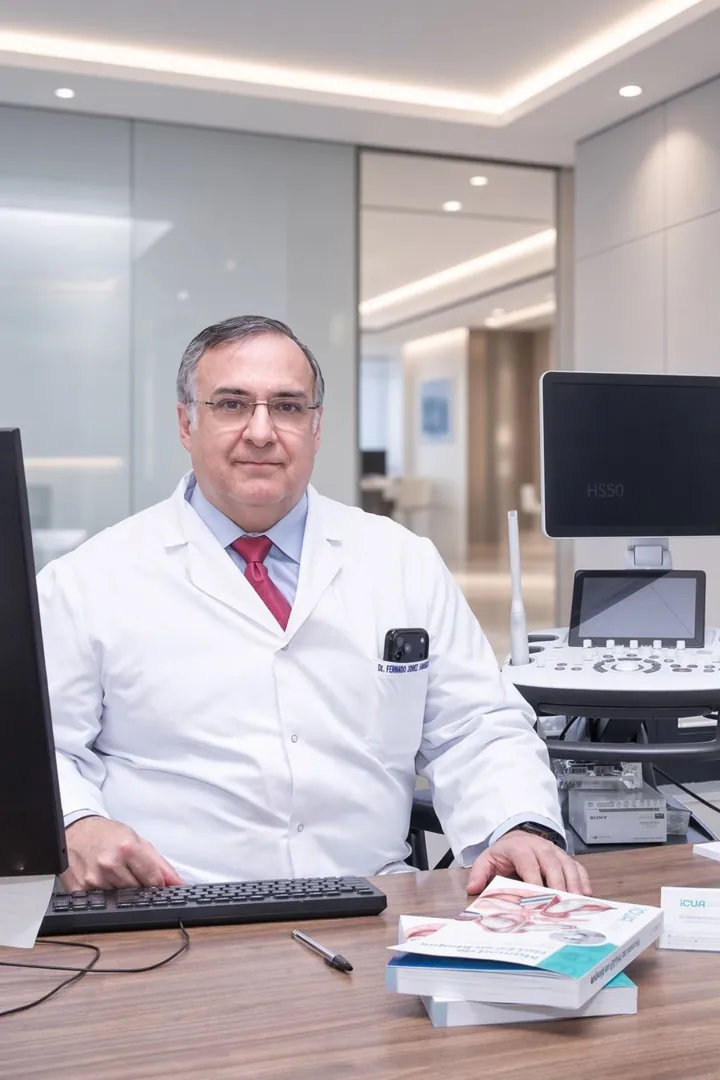
I am a urologist and the Medical Director of ICUA (Instituto de Cirugía Urológica Avanzada) at Clínica CEMTRO in Madrid. My work is anatomical endoscopic enucleation and en bloc HoLEP with early apical release; I teach the technique to urologists from half the world, and I wrote The En Bloc HoLEP Manual (also in Spanish).
I was first author of the 2015 paper describing the move towards anatomical enucleation and the en bloc approach,1 senior author of the 2019 technique series,2 and I have contributed to the multicentre studies on early apical release and en bloc enucleation that I cite in this guide.5,6,9
On YouTube I keep two playlists you may find useful: “The Prostate Explained by Dr Gómez Sancha”, made for patients (also in Spanish, Portuguese, Italian, French, German, Arabic), and “Real life HoLEP Cases”, complete recorded operations for urologists.
Two journals have interviewed me about the technique, training urologists and my career: the E.O.E Newsletter of the Hellenic Urological Association (issue 41, 2026) and Controversias & Urología. Read both interviews in full ↗.
In a colleague's words
Transcript
It is my privilege tonight to introduce a speaker who truly embodies the spirit of innovation, technical excellence and global mentorship in our field, Professor Fernando Gómez Sancha. Professor Gómez Sancha is most well known for refining the en bloc HoLEP technique. He has performed many live surgeries and proctored cases in different countries. But he is not just a true master of his craft; he is also active academically, being involved in various global multicentre studies and publishing extensively in high-impact journals, and has written a textbook on the en bloc HoLEP technique. But perhaps his biggest contribution to the urology community, apart from all his achievements, is actually freely sharing his knowledge, in a way open-sourcing his expert insights on YouTube, and this has benefited a great number of BPH surgeons around the world. Many Padawans will claim him as their master, without his consent or knowledge, including myself. So I used to watch his teaching videos, with his running commentaries on full blast, late into the night, and this was to the detriment of a good sleep.
So that you know
These figures should help you ask better questions, not skip the individual assessment: they do not guarantee a result.
I have worked as a paid consultant for Quanta System and for Lumenis, laser manufacturers, as declared in the cited publications.6
Next step
Request a confidential case review
Send me your clinical information and I will tell you what is missing, whether a formal consultation is warranted, and what the next step would be.
First contacticua@icua.es — no attachments, please
Response timesomeone from the clinical team replies within 24–48 hours
How to send your documents securely
Medical records should not travel by ordinary e-mail or social media. Write to me first at icua@icua.es without attaching anything, and upload your documents to SwissTransfer — free, with servers in Switzerland, no account needed — protect them with a password, and send me the download link; the password in a separate message. The files delete themselves after 30 days.
What to prepare
- a short summary of symptoms and history
- medication, especially blood thinners
- PSA history, MRI scans and biopsies
- ultrasound or MRI with the prostate volume
- flow test and residual volume if you have them
- previous prostate or urethral surgery
- history of catheters, infections, stones or bleeding
- your priorities: continence, ejaculation, whatever matters to you
Sending me information does not open a doctor-patient relationship, does not confirm that HoLEP is right for you, and does not guarantee that we will operate. For an urgent symptom, go to your emergency department — never handle it by e-mail or social media.
Privacy (summary)
Controller: Instituto de Cirugía Urológica Avanzada, S.L., Madrid. Purpose: preliminary assessment of your case and, if appropriate, arranging a consultation. Basis: your consent and healthcare provided under professional secrecy (GDPR art. 9.2.a, 9.2.h). Seen only by the clinical team; kept for as long as needed for your care; never sold or shared. Access, rectification, erasure: icua@icua.es. Full policy: icua.es/aviso-legal.
Appendix for referring urologists and colleagues
The evidence, in brief
En bloc HoLEP replaces lobe-by-lobe enucleation with a continuous anatomical dissection; modern variants add early apical release and preservation of the sphincteric mucosa. The most robust comparative signal across studies is operative efficiency. Continence data are favourable in several series, but not uniform across them.
The key studies, summarised
Single surgeon, mean volume 75.6 mL (up to 253); mean surgery 47.6 min; SUI 5.8% at one month, 1.5% at three and 0.7% at six. Observational, no control group.
Randomised to en bloc, two-lobe or three-lobe. En bloc and two-lobe faster than three-lobe; similar postoperative results. A useful counterweight to claims of superiority.
Single expert surgeon; shorter enucleation and operating time, less energy and less one-month stress incontinence with en bloc. Not randomised.
Multicentre; overall incontinence similar early and at three months; absence of early apical release associated with persistent stress incontinence in multivariable analysis.
Eight centres, 787 per matched arm; similar incontinence with and without early apical release, but longer operating time and more early complications (haematuria, transfusion) with release. A relevant negative study.
Consecutive en bloc cases; efficiency kept improving without worsening complications, catheter time or stay.
Single surgeon (644 ≤ 120 g, 110 ≥ 120 g); favourable results in both groups; six-month SUI 0.15% vs 0.9% (p=0.27). Not a comparison with another technique.
Randomised, prostates > 80 mL; en bloc reduced enucleation and operating time and energy; complications and transient incontinence comparable. Both arms used early apical release and mucosal preservation.
What I say and what I do not
What I can state with confidence
That it is feasible, effective and reproducible in experienced hands; that operative or enucleation time is consistently shorter, with less energy, in the comparative studies; that it works for very large prostates in high-volume centres; that early apical release and mucosal preservation are principles worth specific training; and that, on durability, a US registry of 6.45 million patients (Epic Cosmos, 420,611 procedures, 2014–2024) puts five-year retreatment after HoLEP/ThuLEP at 4.4%, below TURP (7.1%) and minimally invasive options (Rezūm® 14%, urethral lift 16%); only simple prostatectomy is lower (1.2%).
What needs qualifying
The evidence for better early continence is mixed; observational series cannot show that the technique alone caused the outcome; “size independent” describes technical range, not the same risk for every patient; and results from one centre need a clear denominator, definition and time point.
What I would never say
That continence is guaranteed, that en bloc is superior to every modern HoLEP variant, that the words “en bloc” on their own deliver any benefit, or that my results as a high-volume surgeon can simply be extrapolated to any centre.
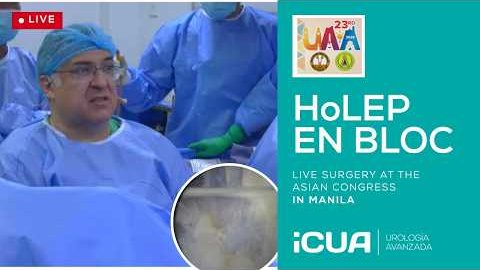
A complete operation on video
Live en bloc HoLEP performed at the Urological Association of Asia congress (Manila, September 2026), with step-by-step commentary. Warning: real, unedited surgical video with explicit views of the operative field and the patient’s genitals.
Watch the Manila live surgery (YouTube) ↗“Real life HoLEP Cases” playlist (98 videos) ↗
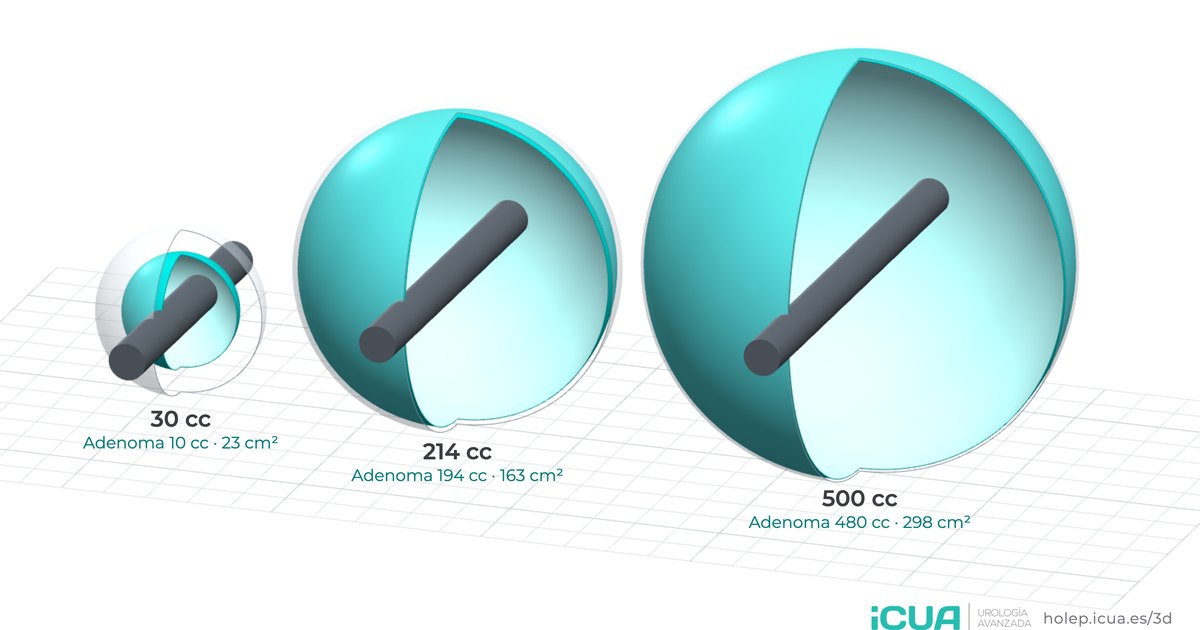
Teaching resource: size independence in 3D
A true-scale 3D model from 30 to 500 cc: the enucleated adenoma grows 48-fold, the dissection plane only 13-fold and the diameter 2.6-fold. It includes the effect of the median lobe and downloadable slides, free for teaching with attribution.
Shared care with the referring urologist
If you are the treating urologist of a patient considering en bloc HoLEP in Madrid, we work with you, not around you. Before surgery, your assessment and records are part of the review; afterwards, with the patient's consent, I send you a full handover — operative report, discharge summary, pathology and follow-up plan, including anything that needs an in-person review — and we agree the follow-up between the two teams rather than improvising across time zones.
To discuss a case, write to me at icua@icua.es identifying yourself as the treating urologist, with a short clinical summary and your questions, no attachments in the first message. I reply within 24–48 hours. If you are interested in training in the technique, say so in the same e-mail.
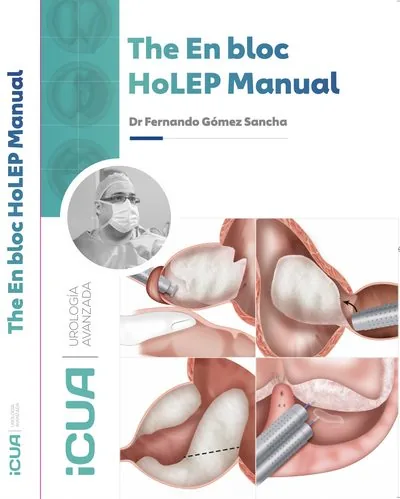
The reference book
The En Bloc HoLEP Manual takes it step by step: anatomical landmarks, early apical release, mucosal preservation and troubleshooting.
English edition →Spanish edition — Manual de HoLEP en Bloque →
Sources
References
- Gomez Sancha F, et al. Common trend: move to enucleation—Is there a case for GreenLight enucleation? Development and description of the technique. World J Urol. 2015;33(4):539-547. PMID 24929643.
- Saitta G, et al. (senior author Gómez-Sancha F). 'En Bloc' HoLEP with early apical release in men with benign prostatic hyperplasia. World J Urol. 2019;37(11):2451-2458. PMID 30734073.
- Rücker F, Lehrich K, Böhme A, Zacharias M, Ahyai S, Hansen J. A call for HoLEP: en-bloc vs. two-lobe vs. three-lobe. World J Urol. 2021;39(7):2337-2345. PMID 33486536.
- Tuccio A, Sessa F, Campi R, et al. En-Bloc Holmium Laser Enucleation of the Prostate with Early Apical Release: Are We Ready for a New Paradigm? J Endourol. 2021;35(11):1675-1683. PMID 33567966.
- Castellani D, et al. Incidence of urinary incontinence following endoscopic laser enucleation of the prostate by en-bloc and non-en-bloc techniques: a multicenter, real-world experience of 5068 patients. Asian J Androl. 2024;26(3):233-238. PMID 38265232.
- Gauhar V, et al. Influence of Early Apical Release on Outcomes in Endoscopic Enucleation of the Prostate: Results From a Multicenter Series of 4392 Patients. Urology. 2024;187:154-161. PMID 38467289.
- Wenk MJ, et al. The long-term learning curve of holmium laser enucleation of the prostate (HoLEP) in the en-bloc technique: a single surgeon series of 500 consecutive cases. World J Urol. 2024;42(1):436. PMID 39046537.
- Choudhary MK, et al. Comparative Outcomes of En-Bloc Holmium Laser Enucleation of the Prostate and Transvesical Robot-Assisted Simple Prostatectomy for the Management of Benign Prostatic Hyperplasia: A Propensity-Matched Analysis. J Endourol. 2025;39(1):57-63. PMID 39589800.
- Iscaife A, Rodríguez Socarrás M, Talizin TB, Nahas WC, Fernandez del Alamo J, Cuadros Rivera V, Gómez Sancha F, et al. Contemporary results of En Bloc HoLEP for large prostates. World J Urol. 2025;43(1):401. PMID 40586952.
- Elmorsy YH, et al. A randomized controlled trial comparing en-bloc vs lobe-by-lobe HoLEP: surgical efficiency and early continence outcomes. Prostate Cancer Prostatic Dis. 2026;29(3):551-557 (published online 6 Nov 2025). PMID 41198920.
- Carletti F, Tamborino F, Turcan A, et al. Five-year Retreatment and Medication Restart Rates Following Benign Prostate Hyperplasia Treatments: A Nationwide Real-world Analysis Using Epic Cosmos. Eur Urol Focus. 2026;12(3):383-392. PMID 41558957.
Transparency
Fernando Gómez Sancha is first author of reference 1, senior author of reference 2 and a co-author of references 5, 6 and 9; reference 9 identifies him as the single operating surgeon. Reference 6 declares that he is a paid consultant for Quanta System and Lumenis.
Questions about this guide?
Educational assistant: answers only from this guide. It does not assess individual cases and is not medical advice. Please do not include personal data — the conversation is not stored.
Urgent symptoms? Seek local medical care immediately.

ICUA travel assistant
AI-generated avatar · not a member of staff
A short video conversation, in your language, on how to plan the trip to Madrid for en bloc HoLEP:
- which reports to prepare and how to send them safely
- how many days to stay and when to book your flight
- discharge, the flight home and follow-up at home
This is not a medical consultation: it does not assess cases or give prices. Please do not say your name, date of birth or medical details. Your voice is processed by Tavus, a provider based in the United States. If you have an urgent symptom, seek emergency care.
To have your case reviewed, write to icua@icua.es.
To have your case reviewed, write to icua@icua.es.