
Professional education
HoLEP Difficult Cases — Tips and Tricks for Challenging Prostates
Dr. Fernando Gómez Sancha · ICUA
Dr. Fernando Gómez Sancha · YouTube
Language: English. YouTube audio metadata.
Professional education. May contain surgical footage.
Playback connects to YouTube. Your search query is not sent to the player.
About this video
Based on automatic YouTube captions; not clinically reviewed. Check technical details against the video.
A lecture on challenging HoLEP cases, based on the speaker's surgical experience. The automatic captions cover maintaining orientation, controlling the laser effect and working with the operating-room team. They also discuss large glands, reoperations, limited access and the decision to stop when continuing would exceed the surgeon's safe limits.
More than laser settings
The lecture considers working distance, speed of fibre movement and aiming direction alongside the laser settings. These points explain why the speaker treats handling and control of the dissection line as central to navigating a difficult case.
Reoperations and altered anatomy
The discussion of retreatment emphasises altered landmarks and assessment of residual tissue. Other sections address restricted access and the practical problem of moving a very large adenoma into the bladder.
Recognising when to stop
Near the end, the speaker explicitly discusses stopping and returning on another day if it is not safe to continue. That discussion places judgement and recognition of the surgeon's limits alongside technical proficiency.
Documented details and sources
Only details explicitly stated in the sources. Missing information does not mean it did not occur.
No clinical case details have been extracted for this video.
Original title and description on YouTubeSource checked: 2026-10-06.
Available transcript · English
Automatic transcription of the original audio, with a preliminary textual review. No human listening or clinical sign-off is claimed. Eleven unresolved passages are marked in the text; check technical terms, drug names and recommendations against the video. Complete audio accuracy has not been verified.
They may contain transcription or translation errors; check the explanation in the video.
- Hello, this is Fernando Gómez Sancha, and I'd like to thank the organizers of the meeting for inviting me to participate with this talk on challenging cases with some of my personal views and experience.
- I'm sorry I cannot be there, but I will try to record the lecture so you can still see me, and I'm sorry I cannot connect, so we will not be able to interact for the meeting. many challenging cases for many reasons and you never know which case is going to be challenging before you start there's no way to predict but of course sometimes we find these cases that are a little bit more difficult in general I would say that en bloc is an appropriate approach for for almost all difficult cases.
- But to me, the most important way to tackle a difficult case is with the correct attitude. You have to have a technical attitude, not an emotional attitude. If you get stressed, if you get anxious, then the case becomes much more difficult and your chances of finalizing the case successfully are much lower.
- it's important to have a very structured and fine surgical technique you have to train your skills with the easy prostates so that every movement counts and exquisitely maintain your lines of dissection so you get orientation you get you you know where the plane is you don't get lost for that it's very important to understand the different effects that you can obtain with your laser you're using and you need a team that supports you because if you can focus on your task and you can rely on other people in the operating room to do what they have to do look after the morcellator take care of the water so it doesn't you know this reduces your your need to be in control of everything in the operating room and you can focus on the task
- at hand. En bloc uh it's it's it's based many people talk now about holep you know you wouldn't consider that a guy who's done 300 cases is an expert in TURP for example but for some reason everybody talks and when you have HoLEP when you do HoLEP you start talking in a professorial way and you start thinking telling your opinions and I think it's important to to to to to realize that this this technique that uh we are proposing the en bloc technique with the preservation of the sphincter mucosa is a technique that is based on on a lot of experience and a lot of meditation about different aspects of the operation and uh on the concept that a progressive mobilization of the apex is paramount to preserve continence of course there is an uh a guy who invented this
- much before we started doing it which is hiraoka the japanese surgeon in 1986 and to him i think we we we have to uh be grateful for for his uh concept but of course the cause of incontinence in classic HoLEP is not looking after the mucosa of the sphincter i think the white line line and the careful dissection of the apex is paramount if you want to have good continence we have already discussed this before this white line will prevent the you know tearing of the mucosa of the sphincter and we will be able to preserve it and this will result in perfect continence En bloc HoLEP is a careful liberation of the apex to protect the continence mechanism you are familiar with the steps we discussed them last year uh to me what i reflect more and more is that
- it's very important to respect these lines you know until you you get a circumferential line around the adenoma this mobilization of the apex going a little bit towards the bladder neck not staying only very close to the apex will give mobility and these incisions that we do to access access the the plane uh even on the adenoma at the beginning are very important to have access to to be able to do this Liberation so these are important concepts things that we understand much better now and then you know the descent and the mobilization of the apex allows you to connect [connection direction unclear: and digitally] and then you have a nice line that you have to follow so en bloc is a very nice
- approach I recommend you to try it uh when people reach you know confidence with real technique they in their comfort zone you you should try this and you should understand how it works and uh well you're familiar with the steps I don't want to spend too much time with this the idea is that after HoLEP you get a patient who you know is going to be perfectly continent from the first moment and this is a great move forward also another concept that you have to know is that the settings of the laser are only playing a limited role you know we have the possibility of adjusting energy frequency pulse length and sometimes we have special modes like pulse modulation and i think but there are other factors that are super important
- another factor is the working distance you have to master the working distance because because then you control the effect the laser is going to have on the tissue so whenever you're operating concentrate to check if your distance is correct to what you want to achieve because it's very very subtle with different distances we have different effects this also happens with pulse modulation Moses and virtual basket another factor is the speed of movement of the fiber you You know, when you're dissecting your line, you can move very fast, you can move very slowly, you can move too slowly, you know, and that is going to influence the effect on the tissue, the quality of hemostasis.
- So it's not only the settings of the laser, it's how you use the fiber. And look at this picture because it's very important. Once you have established your line of dissection, then following this line, judging if you stay in the plane, if you go into the adenoma, or if you go into the capsule, it's very easy.
- the effect of the laser you can do it extremely safe safely and progress towards the bladder neck and then the fourth determinant is going to be the targeting where do you point your laser towards you know the angles of a prostate change as you progress in the operation and then you could fire against the line of the dissection a little bit inside of the line of dissection or a little bit outside and my recommendation is to fire against the line at the beginning when the angles are up, going up and going down.
- And then in the second half of the operation, you're going to have to behave like the motor driver, the motorist, because you need to get closer to the adenoma. And this is super, super important to do safely.
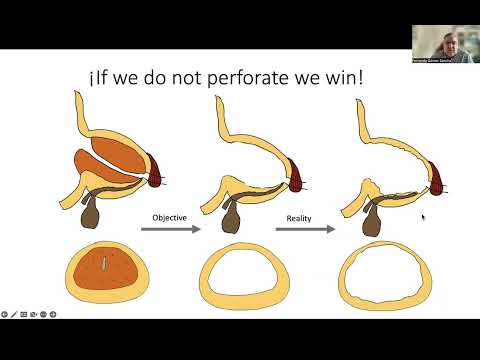
- The dissection, for example, of the posterior plane. If you look in the upper row, when you fire closer to the adenoma than the line of of dissection you're going to be able to develop the plane without damaging the capsule if you fire against the line the capsule is getting perpendicular to the fiber and then you can do some damage so think about these things and if you want to avoid perforations I always say small perforations are allowed but big perforations are not allowed because once you see that the capsule absolutely stealing you should correct your aiming and uh okay so let's move forward uh there's [Transcript uncertainty: Capsular change.] another concept that is important you know often we will lose the plane we will not be in the
- anatomical plane sometimes we don't see it very well the important thing is not perforating you know if we sometimes you know we can go deep we can see the seminal vesicles or the you know uh ejaculatory duct it really doesn't really matter clinically it has very little clinical consequence so but uh avoiding to perforate is very important and and you will finish a case and you will be happy and the patient will be happy also morcellation we know the principles you you know morcellation is very safe if you follow these principles and it's important to have good help and you know follow the rules we've gone through this before we know we know how it is so let's talk about big prostates you know this is one of the difficult cases of course you need
- to have enough skill enough dexterity if you are very slow it doesn't make sense that you try to do a very large glands you know you have to train your ability to become proficient and And my advice is to go slowly.
- You need to pay as you go with hemostasis. You need to do very good hemostasis and keep very good hemostasis so that things do not get complicated. Be very careful with the line of dissection and be very calm.
- You know, many times you start getting anxious right before you finish the enucleation. You know what I mean? Sometimes you're getting anxious and it's almost done. So of course inform the patient that he might need a second stage keep the the the idea that if you're irrigating a patient for too long it might be dangerous so we give furosemide to the patients and one of the nice things of en bloc is that the scope usually reaches the bladder because because some people in America are doing a lot of perineal urethrostomies and I think most of the times in my experience I have never done a perineal urethrostomy for HoLEP and I have treated large glands I think en bloc has many advantages even for the very large prostates
- what about redo cases you know when you have to do a redo the anatomy is altered the landmarks are changed my recommendation is that you always try to do an en bloc technique looking for the plane going around the adenoma and exploring even the areas where you think there's not much tissue because most of the times you're going to see that despite the endoscopic look there will be tissue there okay so always go for en bloc don't remove nodules because these patients have already have previous operation. This is the second, the third. This week I did a guy who had five previous operations and he still had some apical tissue that was obstructive. So try to do a good job and get the patient free from symptoms and solve the problems once and for all.
- So this is my advice for redo cases. With Urolift, you know, Urolift has these clips that can damage the morcellator blades and can be a problem so you will have to morcellate very carefully with the clips there's not much difficulty for the enucleation and the laser usually can catch the the clip another situation where you can find [Transcript uncertainty: Action on UroLift clip.] difficulties to enter the urethra so I love to use the Otis urethrotome typically I use it more more for the navicular urethra but if you have a low caliber urethra and you see that the endoscope is tight of course you can follow Felipe's advice and invest in low caliber instruments but if you if you don't have them then the Otis urethrotome in the anterior urethra will enlarge the the
- the caliber of the urethra will avoid that the presence of the scope inside the urethra causes ischemic damage you know during during the operation and of course always we have this situation where we think is the patient trouble caused by the urethral stenosis or is the patient's problem from the prostate sometimes you see a stenosis that is not critical but then the you know 150 grams so often we have to go in and and do the the prostate even when there is a small [Transcript uncertainty: Incomplete object.] there was a time when i would do a urethrotomy and then leave a catheter and ask the patient how he's voiding but in the majority of cases i have to re-operate again so you have to you have to make a clinical judgment if if the you find a tight membranous
- urethra of these cop scholars which are quite common near the sphincter i prefer to use a [Transcript uncertainty: Narrowing name.] progressive urethral dilatation and then of course if you have smaller scopes i think it's a good idea many many people tell me you know if you do a big gland how are you going to flip it into the bladder so i think it's uh it's possible maybe not always you know i have had to split there times when they're very large but in general if you push the one of the lobes into the bladder and then you you don't push the other side in in the in the other direction you know you just try to follow the rotational movement just like you know a baby's rotate inside the birth canal so
- you try to rotate the adenoma and with this rotational movement I have flipped huge glands glands into the bladder without any problem you can also try to do morcellation inside the capsule but sometimes it's very slow at the beginning and it takes some time but there are ways around it I think en bloc dissection is always worth it if you find this problem then of course there's a way out of it also a very interesting thing I see sometimes you know patients who had a TURP but who develop a bladder neck sclerosis you know in these cases what i like to do is i like to enucleate the i do an en bloc again so try to enucleate the the adenoma completely and remove the fibrotic scar in the bladder neck and then i often inject trimzinolone [Transcript uncertainty: Drug name.]
- in the in the bladder neck to try to prevent a re-sclerosis but i think even when the bladder neck might stricture again if they don't have adenoma remnants sometimes you see bladder necks that are not very big in caliber but excellent flows so i think this would give the opportunity the best chance of curing their problem also often you find stones often you know they are sometimes you just find them for some reason you didn't see them or you know they developed so sometimes they're come as a surprise so I tend to remove the smaller ones if I can endoscopically and if try to reduce the the the stone burden and then I always try to to fragment these stones if you have a massive case then it might be very efficient to do the enucleation of the adenoma
- a cystotomy to remove the adenoma and the stone the big stone but this is again clinical judgments with the new lasers i think it's getting more and more doable to do very large cases very large stones then anticoagulated patients anticoagulated patients deserve a lot of attention and care because i shouldn't believe in what you know companies are telling you sometimes sometimes and even colleagues who tell you no I do anticoagulated patients without any trouble with this laser blah blah blah the truth of of the matter is that you should be careful with these patients bleeding from from the prostate can be very you know life-threatening so I think the the main problem is to fight with the anesthetists or the medical doctors the internists
- you know because they always want to restart anticoagulation very fast and I try to hold it and start with lower doses because these patients can bleed even with Moses with Quanta with you know any kind of any kind of laser and when they bleed it's a tragedy so I think it's important to try to evaluate what is the risk of not having a anticoagulation allow for a good primary hemostasis and then of course you have to tell the patient that it's very likely that he will have hematuria for a long time usually long low grade mild hematuria but for a long time uh also sometimes when you're teaching you know you you are teaching someone and he gets into into trouble and then it's your role to take over you know uh of course these can be challenging
- sometimes because you're not used to encountering this situation and I have to tell sometimes it's it's tricky so try to reconstruct the line of dissection and try to be very very systematic and careful and try to keep your you know horses and uh to be nice to whoever was learning and try learning situation. Also often we find a lot of stones inside the prostate, they're not very common cases but this lithiastic prostatitis cases sometimes can be challenging because you start having thousands, hundreds of fragments inside the fossa so sometimes well you might need to do a three-lobe technique, you know open some kind of access to the bladder the bladder so that the stones can go into the bladder and you get some space but again
- and also it's important I think to remove all the lining of these crypts and cavities don't leave it there go under these cavities to try to remove everything and leave a fresh wound in the prostate that will heal without causing cavities that could later on get infected or form new new stones. Also a common situation is that we find an incidental bladder tumor during enucleation.
- So of course you shouldn't do the tumor first because when you do the morcellation you're going to distend the bladder and there could be extravasation. So my recommendation is to do the enucleation and morcellation first and then you go to the tumor. If you have a laser already and the the tumor is amenable for laser en bloc enucleation that's a good option sometimes we we have done that and it seems to be oncologically safe to do that so removing the prostate and doing the tumor at the same time seems not to be a big problem and this is something that we face occasionally because some tumors are not easy to see especially in in the context of trabeculated bladders.
- Also, bladder diverticulums, we can treat them endoscopically. Of course, if they're very large, probably it's not so easy. I would say that in patients with very large diverticulums, I tell them, let's do the enucleation first, because in my experience, 90% of the patients will have no problem later on, except maybe double micturition.
- but I tell them maybe if the diverticulum gives you you know infections or trouble then we can do a laparoscopic or robotic diverticulectomy on the second stage but in the majority of cases they do well they live with a good quality of life so there's no need to to tackle the diverticulum but in the smaller or medium-sized diverticulums I think it's interesting to know that if you you coagulate the whole diverticulum with a rollerball and you leave the catheter for three or four days the chances are that the diverticulum is going to be collapsed and there will be some fibrosis in the area and then you will get rid of the diverticulum so especially if the diverticulum contains stones or you know you can't consider this as well you keep the catheter a little bit [Transcript uncertainty: Negative wording.]
- bit longer and maybe give a better chance for the patient to recover better and prevent other problems in relation to the diverticulum. The big nodules, the big nodules can make a case challenging. You know, I think some guys tell you cut through them, leave them there, vaporize them, but I think it's important to understand that these nodules will thin the capsule, capsule but the capsule still is there it's very thin sometimes it's a little bit scary when I'm teaching people I can see their faces you know they're a little bit what is he doing where is he going how deep is that but uh of course if you can aim your laser properly and you know how to use the energy so you don't perforate in that situation I I enjoy a lot these cases removing
- removing these big nodules and I think the chances of the patient to be cured from their you know voiding problem forever are much better if you don't leave this probably rapidly growing nodules in the in the in the fossa again often you can see you know old patients maybe in retention nobody did a PSA nobody did a rectal examination when you go in you find a nasty prostate cancer Well, these things can happen and you have to know that often the plane is very difficult and you find all kinds of things in there, especially in the high-grade tumors.
- You can find papillary tissue, you can find yellow tissue like that. It's very difficult. you can always try to define a line sometimes is a line that you think is going to provide with good deobstruction and they can bleed more postoperatively because of the characteristics of the tissue and the increased microvascularization uh I think they do better these patients than the patients who are submitted to a channel TURP people with channel TURP could come back again again obstructed and often the prostate is big so enucleation I think is a good option for these patients to keep them voiding you have to be careful with the sphincter because sometimes the sphincter could be infiltrated not very functional maybe the risk of incontinence is
- a little bit uh bigger and also sometimes the tissue is very hard and difficult to morcellate so often I keep the tissue hanging from the bladder and I can do a TURP of this tissue issue radiated patients you know I used to work with Tony Monday I did a fellowship in London [Transcript uncertainty: Name spelling.] with him and he used to say that radiotherapy is the devil's work uh in my experience external beam is not a problem you can find the plane and you can do HoLEP maybe not very easy not very difficult it there's some variability but in in general you can do external beam carefully of course I would be careful with the plane try not to go very deep you know maybe you you have to be a little bit
- more careful in this in these cases but with brachytherapy my advice would be to run away from the patient you know don't do big enucleations or big big operations in patients who had a brachytherapy you know maybe i would even consider doing a careful TURP doing a couple of cuts they're usually small prostates to try to keep the patient voiding you know sometimes here the good is the enemy of the better in these patients and they can get very bad complications and even having to have a colostomy or you know because this this this tissue after brachytherapy responds response very very variably so in my experience try to to run away from these patients if you can then of course we have the difficult access you know we have extreme cases of course if you have
- a big hydrocele you can get the light source light source from the endoscope transilluminates the testicle put a needle in empty the hydrocele so you can do the operation and warn the patient that it will grow back again uh you can have hypunculosis that uh so i had two two helpers [Transcript uncertainty: Condition name.] with the legs of the patient so they would move them up a little down a little to try to you know uh two guys holding the the leg for the length for the length of the operation you know trying to get access to the prostate and be able to enucleate extremely fat uh patients well you will have to use your imagination semi-rigid prostheses are challenged because sometimes you cannot reach
- the bladder neck with the scope and i have done the enucleation in patients with semi-rigid prosthesis trying to put a little bit of tension trying to put the fiber more inside trying to avoid to do a perineal urethrostomy but i'm sure there are cases where you cannot avoid this this possibility so our reflection i think which is important it's always safer to put a [Transcript uncertainty: Incomplete phrase.] back another day, if things get difficult. So if you do a difficult case, and you find that you are out of your depth, I think it's probably safer to put a catheter in and tell the patient it was not safe to continue. You will never regret that the patient will be thankful to you, he will trust
- you. And if you have to pay, you know, if you have to pay for the second operation, pay gladly, because, you know, you will always feel better doing that that having a patient with a bad complication that uh you know is a problem in his life because of your bad judgment so that's my advice it's never wrong to stop if you find that things are getting very difficult so in conclusion i think the most important factor is to use a technical approach not an emotional approach people are very anxious when they do HoLEP i don't know why it's just another operation and if you have this attitude relaxed and calm progress slowly carefully keep faithful to the principles of this operation you trust that everything is going to turn out well you know everything will uh be okay
- and if it doesn't you put a catheter and come back another day it's it's something that surgeons you know we have our limits and we have to recognize that and in conclusion again and i like this slide you know you have to consider a pro if you don't do HoLEP or enucleation you have to do it we have [Transcript uncertainty: Incomplete introductory phrase.] better tools we have better techniques and i think there has never been a better moment in history to learn enucleation so again thank you very much for the invitation to the meeting i hope it's a big success i know that brazil is boiling with with desire to do HoLEP and to incorporate HoLEP and there's many individuals over there that are pushing it forward and i want to to to recognize
- my admiration for all of you for what you're doing and i hope uh you achieve to change the landscape in brazil so that open prostatectomy is a thing of the past and TURP is relegated to a very very honorable place in history but in the past as well so thank you for your attention and see you around if you want to come and visit us sometime just let us know thank you bye bye