
For patients
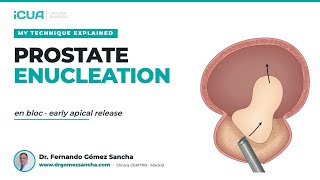
En Bloc HoLEP with Early Apical Release — My Technique Explained
Dr. Fernando Gómez Sancha · ICUA
Dr. Fernando Gómez Sancha · YouTube
Language: English. Editorial classification in the patient catalog.
Playback connects to YouTube. Your search query is not sent to the player.
About this video
In this video, I explain the surgical technique that defines my work as a urologist: en bloc enucleation of the prostate with early apical release and sphincter's mucosa preservation.
Documented details and sources
Only details explicitly stated in the sources. Missing information does not mean it did not occur.
No clinical case details have been extracted for this video.
Original title and description on YouTubeSource checked: 2026-10-04.
Available transcript · English
Automatic YouTube captions; they may contain errors.
They may contain transcription or translation errors; check the explanation in the video.
- Today, I want to explain something that defines [music] me as a surgeon. If you look me up, you'll see that en bloc enucleation with early apical release [music] is mentioned a lot.
- It sounds technical. It sounds complicated, but the concept's very simple, and I want you to understand it because [music] it directly affects the results of your operation. I am Dr. Fernando Gomez Sancha. I've been performing laser prostate procedures for over 20 years, and I developed this technique that is used today in centers all over the world.
- I presented it for the first time at the European Association of Urology Congress in 2010. I published it later a few years after that. Since then, I've taught it and promoted it in more than 50 countries, and I've trained more than 600 surgeons to learn this technique.
- To understand en bloc enucleation, first you have to understand the standard holmium laser enucleation technique. In conventional HoLEP, the surgeon enucleates the prostate in two or three lobes. I separate the middle lobe, then the left lobe, then the right.
- Three pieces or two pieces. It works well, but it has some limitations. My technique is different. Instead of separating lobe by lobe, I enucleate the entire prostate in a single piece. It's like peeling a whole orange instead of going segment [music] by segment.
- Hence the name en bloc. And what is early apical release? The apex is the most delicate area of the prostate, the closest to the urinary sphincter, the muscle that controls urinary [music] continence.
- In the conventional technique, the apex is addressed at the end [music] when you've already been operating for a while. And classically, [music] this three-lobe technique had very little regard for the urinary sphincter.
- In my technique, I perform a release of the apex [music] area at the beginning. With perfect vision, I can precisely identify where the prostate ends >> [music] >> and where the sphincter begins. And why does that matter to you as a patient?
- Well, for three reasons. The first is urinary continence, the quality of urinary continence. By identifying the sphincter with maximum precision at the start of the surgery, the risk of damaging it is minimal.
- Our early incontinence rates are very low, and our permanent incontinence rates [music] are 0.something percent. The second is efficiency. By working in a continuous [music] anatomical plane, the surgery's faster, more fluid, there is [music] less bleeding, and the operative time is reduced, especially in large prostates.
- And the third is completeness. That is, the fact [music] that we remove all the tissue in a single piece makes it easier to ensure no remnants are left. This explains why our long-term retreatment [music] rates are less than 2%.
- If you take it all out, it doesn't grow back. Let me offer an analogy I use with my patients. Imagine you have a mandarin inside its skin. You can take the mandarin out piece [music] by piece, pulling out the segments and leaving some stuck to the to the skin, or [music] you can separate the whole mandarin in a single maneuver. In the end, the skin [music] is left clean with no remains, the peel, the the prostatic capsule.
- And this is en bloc enucleation. Do all surgeons who perform laser enucleation use this technique? No. Many excellent surgeons perform HoLEP in two lobes or three lobes with very good results as they gain more experience.
- The en bloc technique is a little more demanding to learn at first, but I believe it offers real advantages, [music] and the data from our series back it up. What makes me most proud of this technique is that it hasn't stayed in my operating theater. I've trained hundreds of urologists [music] in more than 50 countries to apply it with their patients >> [music] >> because a good technique only has value if it can be taught and reproduced.
- If you want to know more about the scientific data about this technique, in the description, I'm going to leave the link to the publications. Subscribe to the channel, and we'll see you in the next video. [music]