
Surgery
En bloc HoLEP
Dr. Fernando Gómez Sancha · ICUA
Dr. Fernando Gómez Sancha · YouTube
Language: English. YouTube audio metadata.
Surgical content for professionals. Contains footage of an operation.
Playback connects to YouTube. Your search query is not sent to the player.
About this video
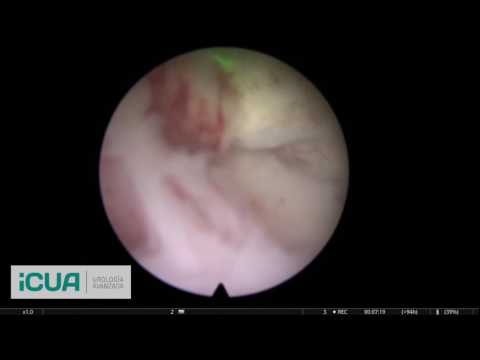
A demonstration of an en-bloc approach to holmium enucleation of the prostate. The description presents anatomical enucleation and the possibility of using different energy sources as the technical subject. It does not identify a comparison between devices or quantify clinical outcomes.
Documented details and sources
Only details explicitly stated in the sources. Missing information does not mean it did not occur.
- En bloc
En bloc HoLEP
Source checked: 2026-10-06.
Available transcript · English
Automatic YouTube captions, not clinically reviewed. Names, technical terms and numbers may contain errors. Check them against the video; complete audio coverage has not been verified.
Selected spellings of enucleation, morcellation and holmium terms have been edited. This is not a full audio or clinical review; the original captions remain the source.
They may contain transcription or translation errors; check the explanation in the video.
- hi this is fernando romesancha from madrid spain i'm going to present this video of a an inbloc hollap holmium manipulation of the prostate i have devoted a great deal of effort to laser prostatectomy and i have had experience with most kinds of lasers available and it is my personal belief that a nucleation is a superior form of treatment for bph and my conviction is that the best way to nucleate
- prostate is probably the end block approach i have described a green light laser and block approach for nucleation of the prostate and this video shows how this and block approach can be used not only with green light laser but also with a holmium laser with a straight firing fiber as you can see a circumferential incision is carried out at the apex marking the separation or the line that separates the sphincter from the apex of the adenoma so progressively one has to go around this incision and especially try to make it a little deep
- and tediously just by the sphincter because this is the most difficult part to dissect when you use a straight firing fiber for this step i think the side firing fiber from the green light lasers is optimal because it's a you can fire upwards without having to tilt the the scope i also like very much to use a special instrument with a blunt tip that allows me to do some mechanical enucleation you can see that i'm not using the laser now i'm just using the tip of the scope to push a little bit and you can see how this push defines very beautifully the the plane the exact plane of the
- nucleation this is a relatively small prostate and in this case trying to avoid using too much force for the dissection i prefer to cut the mucosa first and then use the blunt tip to dissect a little bit more and to make sure that the anatomy is clear and then that we are in the right anatomical plane of dissection before continuing the energy dissection there we go so that is a beautiful interface between the adenoma and the capsule and another interesting point of this technique is that it allows to liberate the apex at the beginning of the operation so as you can see the sphincter is being
- retracted uh backwards as we progress with this dissection that's cutting the crystal arthritis on top of the very montanum this is also a very fibrous structure so cutting with energy is the right way to to do it i think in my opinion and now the plane will be connected in the midline at six o'clock there you go so what i was saying is that the liberation of the apex from the sphincter and there you saw another you know mechanical push but what i was saying is that the liberation of the apex from the sphincter i think protects the sphincter when you are
- putting the scope inside let's say above the adnoma or lateral to it as long as there is any fixation of the sphincter to the tip of the adenoma you're going to stretch the sphincter and that is in my opinion the mechanism by which some patients can develop postoperative temporary stress incontinence because the sphincter was anatomically respected but it was badly stretched during the operation so that's why i think liberating the sphincter as the first step of the procedure is a good idea because once it's completely liberated from the apex you'll see that we will achieve that in some minutes then the scope can move around the adenoma
- circumferentially without exerting any traction on the on the sphincter okay so that's one side you see one comes up trying to follow the anatomical plane for nucleation until 12 o'clock and here there are some fibers that are difficult to cut with a straight firing fiber that's the difficulty of using straight firing fiber in this step so that's why sometimes i think that we should be using maybe different fibers for different steps of the operation now it would be much more appropriate to use the side firing fiber for that part of the abrasion why not change the fiber for another one just to complete this brief step and then go back to
- to the straight firing fiber for the rest of the procedure we do that all the time with other operations where we use specific instruments for specific steps of the operation and you see one of the beautiful aspects of this technique which has also been recognized by other surgeons i think kim was presenting a very nice and blob technique as well he called it all in one with the tunium laser you see once you can go around the adnoma like this then this becomes very easy because the line of attack is very very obvious and the difficulty that many people have uh finding the plane in the whole new
- nucleation becomes uh no longer a problem as you can see one has to fire preferentially against the edge of the adenoma so you you target the attack line the line of attack the line of dissection but you keep the beam a little bit more close to the norma than the capsule this way you will preserve the capsule you will not perforate it and uh you benefit from the shockwave created by each pulse of this laser that will dissect the adenoma from the capsule
- and one has to have a very very careful management of the fiber tissue distance so you get just the necessary coagulation effect on the tissue so as you progress you can control bleeding so you can see now the fiber is dissecting the adenoma from the capsule in a circumferential fashion so now we are on the left side of the patient but one can follow the anterior plane as well this is the lower part you can circumferentially attack the the prostate trying to do an
- even line of attack and to progress towards the bladder neck circumferentially this is a beautiful technique and i think it is probably much faster than than traditional techniques for for a nucleation because you don't have to spend time making deep incisions before starting the nucleation so here you spend two or three minutes performing the initial incision at the apex and the rest of the time you are a nucleating tissue so it's very fast it keeps the operation time short which makes it an even more attractive
- procedure in this case this was not a very large land but we could perform the operation in only 20 minutes it is very very fast there you go once you are able to understand how this procedure works i think it would be relatively easy to teach to other urologists i think the homium laser nucleation is probably not so difficult to learn as it has been said many times but it has been taught very badly in the past
- if one wants to learn to perform homium a nucleation of the prostate my advice would be that one has to watch many procedures before considering to to try and do it many times we run to try and learn by doing but i think in this procedure it's very important that whoever wants to learn watches many procedures 10 20 before sitting down with the patient and and start trying to to execute the procedure with the help of a mentor so i think this is the first step and once you have seen many procedures you understand how to use the fiber and how to tackle
- the interoperative problems then you can start with the with the help of a mentor you can see in this case we are reaching the bladder neck anteriorly so for that you have to follow the contour of the adenoma and it's important that you understand that the prostate is spherical so when you dissect the anterior plane you have initially to direct your fiber let's say pointing anteriorly and then as you go over the curve of this sphere which is the abnorma then you can tilt the fiber again down anteriorly to reach the the bladder neck so by following the plane keeping
- close to the abnormal but still in the anatomical correct plane then you can reach the bladder neck anteriorly here this is the left side coming up and when you see that the fibers start changing initially you see at the bladder neck level and literally you have to see that the fibers start to become vertical this is a very subtle way to recognize here we are under the adenoma again trying to release the lower part as much as possible you see this is what we have achieved up to now which is 12 and a half minutes off of surgery we are now starting to reach the bladder neck area
- this lower dissection has to be very careful because there is a potential to undermine the bladder nick so it's more than ever important to keep close to the ladder neck so most of the energy goes to the adenoma rather than the capsule where you could easily perforate if perforation happens uh well you have to be vigilant maybe lower the the height of the irrigation fluids keep palpating the abdomen to see if there's any extravasation we like very much to use intraoperative ultrasound to have a transaction ultrasound in the operating room so you can always stick the stock depression and do a transactional ultrasound to evaluate if there's any significant extravasation most of the times
- these perforations are minor and they have no consequence here's where i'm telling you the fibers are changing so this is a an unequivocal sign that we are entering the bladder you see that's vertical fibers now and there we go and once the mucosa is cut one can enter in the bladder and and there you go the blur neck is opened anteriorly now it is a matter of incising the bladder neck circumferentially if the dissection has been carried out strategically you see trying to develop the lower part of the dissection quite aggressively before entering the
- bladder deck then there remains uh very little tissue there and one can can cut the bladder neck here i'm checking for the retro orifice which is quite far away and now you can see that the prostate is going to be released the adenoma is going to be released into the bladder in one piece so this is a variation of the traditional hormone laser nucleation technique that i think personally gives you the best fastest way to remove the prostate it is extremely comfortable it's very difficult to get lost with the plane and uh i think it will progressively become a favorite approach for the majority of uh expert
- uh surgeons in laser nucleation i also believe it can be taught to new users but maybe then it is very important that they understand the anatomy of the sphincter of the apex here is the final final attachments at six o'clock in the bladder neck and the bladder neck is being cut you see that's the remainder of the bladder neck attachment at six o'clock and the abnormal will be pushed into the into the bladder in one piece so this was a small prostate so it took 20 minutes but i would say that most
- prostates maybe not the the huge extraordinary cases but most prostates can be nucleated in under one hour also with the development of the faster morcellation blades from the brannia system we can we can do a very very fast marcellation that takes only minutes you have to understand that this is not an edited video clip it's just a complete video clip we did not cut anything and you see it's been 16 minutes now so that's the time the inclination took place in this relatively small prostate gland i think it was something like 40 or 50 grams of total volume and you can see and distinguish the
- capsule it's been an anatomical dissection following that plane and after checking hemostasis we can proceed to change the instruments to start the musculation of the tissue there you go laser prostatectomy is evolving fast and as we get more and more experience we tend to try new new new ways of performing things that are more and more efficient and also quite safe these patients typically have a catheter overnight and catheter is removed the next morning
- i have a fast-tracked way of removing the catheter which is initially we wash out the bladder you can see the preservation of the sphincter is magnificent this is great so these patients are going to have perfect continence and perfect the obstruction durable everything you would want from from a prostatectomy there we go so now i'm going to to change the instruments basically we need to introduce a very thick uh more solution blade into the bladder and that kind of go into the laser system so we change the instrument for a specialized nephroscope morse scope the morse scope
- that allows us to introduce this marcellation blade it's fantastic to use this piranha system with the faster motilation blades because they provide you with a very very fast morcellation speed i believe that once you have good hemostasis more needs selection proper distension of the bladder and then it's this prolonged extension is going to cause bleeding so you have a window of opportunity of 15 or 20 minutes where morcellation has to has to finish so these fast blades allow you to remove even very large clouds in a limited amount of time these blades can go up to 20
- grams per minute and maximum efficiency so the average in our experience is about 10 grams per minute so that means you can remove 100 grams in in in 10 minutes so this is a game changer i think more solution is becoming better safer and that's why everybody should embrace laser prostatectomy and start getting rid of the old-fashioned tyrp which can induce severe bleeding and complications that are avoided with with these modern techniques so i hope you enjoyed the video and don't hesitate to contact me if you want to come and visit sometime