
For patients
BPH Medications: Surgery or Adding More Pills? Polypharmacy
Dr. Fernando Gómez Sancha · ICUA
Dr. Fernando Gómez Sancha · YouTube
Language: English. Editorial classification in the patient catalog.
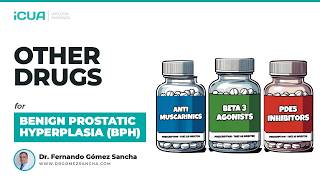
Playback connects to YouTube. Your search query is not sent to the player.
What medicines can achieve
Dutasteride and finasteride can reduce prostate size and, in selected patients, the long-term risk of urinary retention or surgery. Therefore, “none of the pills solves the problem” should not be understood to mean that medicines are ineffective.
Taking several medicines does not by itself determine the need for surgery: response, adverse effects, symptoms and complications are assessed with the urologist.
- Roehrborn et al. The Effects of Combination Therapy with Dutasteride and Tamsulosin on Clinical Outcomes in Men with Symptomatic Benign Prostatic Hyperplasia: 4-Year Results from the CombAT Study. European Urology. 2010;57(1):123–131.
- European Association of Urology. Management of Non-neurogenic Male LUTS: Disease Management.
Editorial clarification based on the cited sources. It does not establish a new medical review of the video.
About this video
Documented details and sources
Only details explicitly stated in the sources. Missing information does not mean it did not occur.
No clinical case details have been extracted for this video.
Original title and description on YouTubeSource checked: 2026-10-04.
Video moments
Available transcript · English
Automatic YouTube captions; they may contain errors.
They may contain transcription or translation errors; check the explanation in the video.
- In another video, I told you about tamsulosin and dutasteride, the most well-known drugs for the prostate, [music] but there are others. Many patients come to my clinic taking three, four, or even five different pills to help them urinate, and most don't really know what each one is for.
- Today, I'll clear that up. I'm Dr. Fernando Gomez Sanchez. I spent 32 years in urology and performed over 10,000 laser prostate [music] operations, and one thing I see constantly is over-medicated patients who aren't improving much.
- So, let's review the drugs you're likely taking, or have been offered, or have tried, and what you can really expect from each one. Let's start with one category of drugs, antimuscarinics. [music] Names like solifenacin, oxybutynin, fesoterodine, tolterodine, darifenacin, or trospium. These medications don't act on the prostate, they act on the bladder.
- What they do is block a neurotransmitter called acetylcholine, [music] which is what tells the bladder muscle to contract. By blocking it, the bladder relaxes, and you can hold on longer without that urgent need to run to the bathroom.
- When are they prescribed? Well, when the main problem isn't the size of the prostate, but an overactive bladder. That urgency, that urinary frequency, that need to get up during the night.
- Sometimes they're combined with an alpha-blocker like tamsulosin, [music] one pill for the prostate and another for the bladder. Side effects? There's a problem here. Antimuscarinics block acetylcholine not only in the bladder, but throughout the body, causing dry mouth, less saliva is produced, which is often very annoying, constipation, blurred vision, and in older people, it can cause or contribute to cognitive decline. This last point is very important. There are studies linking the long-term use of anticholinergics with an increased risk of dementia.
- It's not cause for alarm, but it's something you should know and discuss with your doctor. There's another group of drugs, beta-3 agonists. The best known is mirabegron, and more recently, vibegron.
- These work through a different mechanism. >> [music] >> Instead of blocking bladder contraction, they stimulate its relaxation while it's filling. The result is similar, less urgency, less frequent urination, but with fewer side effects than antimuscarinics.
- They don't cause dry mouth or affect cognition. Are they perfect? No, because they can slightly raise blood pressure, and their effectiveness is modest. We're talking about a reduction of one or two urgent episodes a day compared to taking a placebo.
- They work better when combined with a low-dose antimuscarinic than on their own. Now, let's look at another category of drugs that surprises many patients, [music] phosphodiesterase type 5 inhibitors.
- The best known is tadalafil. Yes, the same active ingredient as Cialis, and from the Viagra family. Many patients are surprised when it's prescribed for the prostate. Doctor, you're prescribing me an erection pill.
- Actually, low-dose tadalafil, 5 mg a day, is approved to treat lower urinary tract symptoms associated with benign prostatic hyperplasia. How does it work? It relaxes the smooth muscle of the prostate, the bladder neck, and the blood vessels in the pelvic area.
- The result is a modest improvement in urinary symptoms, similar to tamsulosin, with the added benefit that it also helps with the quality of erections. If [music] there's erectile dysfunction, it's the only drug that treats both problems at once, the prostate and the quality of the erection.
- Drawbacks, it can sometimes cause headaches, nasal congestion, >> [music] >> intense muscle pain, and it can't be combined with nitrates. If you take nitroglycerin for your heart, it's contraindicated.
- So, what's the real picture? There are patients who take tamsulosin [music] for the prostate, solifenacin for the bladder, tadalafil for erections, and dutasteride to slow down prostate growth. Four pills, each with its side effects, each with modest efficacy, [music] and none solve the underlying problem, the mechanical obstruction caused by prostatic hyperplasia.
- This is what I want you to understand. >> [music] >> Medication has its place. In the early stages, with mild symptoms, it's reasonable. But, when you need three or four drugs to manage the symptoms, or when the side effects affect your quality of life, it's time to consider whether it's better to solve the problem at its root.
- Surgery, such as holmium laser enucleation, definitively removes the obstructive prostate tissue with very low risk. After surgery, most of my patients stop taking all the prostate medication they were on.
- All of it. They no longer need alpha blockers, antimuscarinics, or 5-alpha reductase inhibitors. And that, in the long term, not only improves their quality of life, but also avoids the cumulative risks of years of medication.
- If you're taking several pills for your prostate and bladder, and your symptoms [music] aren't improving, talk to your urologist about the alternatives. In the next video, I'll tell you what science says about natural remedies and phytotherapy for the prostate. Subscribe to the channel and I'll see you there.