
For patients
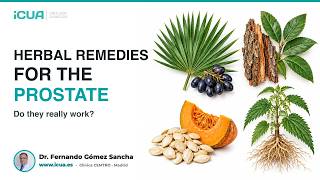
Herbal remedies for the prostate: do they work? What studies show
Dr. Fernando Gómez Sancha · ICUA
Dr. Fernando Gómez Sancha · YouTube
Language: English. Editorial classification in the patient catalog.
Playback connects to YouTube. Your search query is not sent to the player.
About this video
Are you considering a herbal product for prostate symptoms? I’m Dr Fernando Gómez Sancha, a urologist at ICUA. In this video, I discuss herbal treatments and the questions worth asking when you assess information about these products.
🔹 Serenoa repens (saw palmetto), African plum bark, pumpkin seeds and nettle root.
🔹 What has been studied about beta-sitosterol and Japanese herbal preparations.
🔹 How to assess studies, their limitations and advertising claims.
🔹 Why diagnosis matters and necessary treatment should not be delayed.
References and a clarification on the trial name:
Serenoa trials evaluated specific preparations. The beta-sitosterol review distinguishes short-term results from long-term uncertainties.
Documented details and sources
Only details explicitly stated in the sources. Missing information does not mean it did not occur.
No clinical case details have been extracted for this video.
Original title and description on YouTubeSource checked: 2026-10-04.
Video moments
- Saw palmetto: what the studies really say
- No side effects doesn't mean it works
- Pumpkin seeds, nettle root and beta-sitosterol: any use?
- "Natural" doesn't mean regulated: the real problem
- Prostate supplements: when yes and when not
- Herbal remedies for the prostate: do they work? What studies show · 0:00
- Herbal remedies for the prostate: do they work? What studies show · 0:42
- Herbal remedies for the prostate: do they work? What studies show · 1:23
- Herbal remedies for the prostate: do they work? What studies show · 2:06
- Herbal remedies for the prostate: do they work? What studies show · 2:50
- Herbal remedies for the prostate: do they work? What studies show · 3:31
- Herbal remedies for the prostate: do they work? What studies show · 4:14
Available transcript · English
Source: subtitles embedded in the published video.
They may contain transcription or translation errors; check the explanation in the video.
- Doctor, what if I try something natural before having surgery? I get asked that every single week. Saw palmetto, pygeum africanum, pumpkin seeds, stinging nettle. The internet is full of products promising to improve prostate symptoms naturally.
- Today I'll tell you what science really says about each one. I'm Doctor Fernando Gomez-Sancha, I've been in urology for thirty-two years and have done over ten thousand laser prostate surgeries.
- I'm going to give you an honest opinion. Not everything is rubbish, nor does everything work, but there's a huge gap between what ads say and what studies show. Let's start with the most famous one, Serenoa repens, or saw palmetto, or the American dwarf palm.
- It is probably the world's best-selling supplement for the prostate. It's credited with having anti-inflammatory and anti-androgenic properties. For years, small studies suggested that it improved urinary symptoms.
- The reality is, the largest and most rigorous clinical trial ever done, the Step study, published in JAMA in twenty eleven, randomised, double-blind, placebo-controlled, a good study, found no benefit over placebo, neither at the standard dose nor at triple the dose.
- Since then, the evidence has been consistent. Serenoa repens has not shown superior efficacy to placebo in high-quality trials. Is it dangerous? No, it is very well tolerated. But just because something has no side effects, it doesn't mean that it works.
- A mint sweet doesn't have side effects either, and it doesn't improve the prostate. Next, pygeum africanum, an extract from the bark of the African plum tree. There are some studies here suggesting a modest improvement in urinary symptoms, reduced nighttime frequency, and post-void residual.
- But the trials are old, small, and methodologically weak. European and international clinical guidelines do not recommend it as a treatment. Pumpkin seeds contain fatty acids, phytosterols, and zinc.
- There are a couple of studies showing some improvement in mild symptoms, but again, small, short-term trials, lacking the rigour of a level one registered study. The same goes for nettle root, which is sometimes combined with saw palmetto.
- Then there's beta-sitosterol, a phytosterol that is present in many plants. It's perhaps the one with the most interesting data. A Cochrane review from years ago showed improvement in urinary flow and symptoms, but the studies were few, short, and with few patients.
- No one has done a large, definitive trial. And what about the Japanese preparations? Gosha-jinki-gan and hachimi-jio-gan are traditional Japanese herbal formulas that have been studied for overactive bladder.
- Some small studies in Japan show a reduction in urgency and frequency, but we're talking about limited evidence, not replicated in large Western trials. Now, what I want you to understand.
- The problem with phytotherapy isn't that it's natural, the problem is that it's not regulated like a medicine, it doesn't pass the same quality controls. What the label says doesn't always correspond with what's inside the bottle.
- The concentration of the active ingredient varies from one batch to another, from one brand to another. Neither the FDA nor the, nor the European Medicines Agency regulate it as a drug, but as a food supplement.
- Does this mean you should reject it completely? Not necessarily. If you have very mild symptoms and want to try a supplement as a first step before moving on to medication, it's a legitimate option, provided you do so with realistic expectations.
- But it's no substitute for a medical diagnosis, it's no substitute for medication when indicated and, of course, it's no substitute for surgery when the problem is a mechanical obstruction.
- What I can't accept as a urologist is that a patient with urinary retention, with a high post-void residual, with a very large prostate that's obstructing him, with symptoms, is taking saw palmetto capsules instead of receiving a treatment that actually solves his problem.
- This is not natural medicine. This is delaying a necessary treatment. My advice: get informed, ask questions and don't believe everything you read on the internet. If your urologist tells you that you need treatment, listen to them.
- And if you have doubts, ask for a second opinion, but from a professional, not from an internet forum. So subscribe to the channel for more information and we'll see you in the next video.