
Professional education
My talk on the ESU Webinar on enucleation of the prostate
Dr. Fernando Gómez Sancha · ICUA
Dr. Fernando Gómez Sancha · YouTube
Language: English. YouTube audio metadata.
Professional education. May contain surgical footage.
Playback connects to YouTube. Your search query is not sent to the player.
About this video
A lecture from a European School of Urology webinar on different techniques for prostate enucleation. The description links the talk to the wider ESU webinar programme. It does not supply a written comparison of the techniques or their outcomes.
Documented details and sources
Only details explicitly stated in the sources. Missing information does not mean it did not occur.
No clinical case details have been extracted for this video.
Original title and description on YouTubeSource checked: 2026-10-06.
Available transcript · English
Automatic YouTube captions, not clinically reviewed. Names, technical terms and numbers may contain errors.
They may contain transcription or translation errors; check the explanation in the video.
- hi hello this is fernando gomez sancha my talk today is to describe published techniques to perform anatomically nucleation of the prostate similarities and differences i have been a consultant for luminis and qantas system and i am a consultant for these companies so if you look at the task they have given me today there are many different energy sources with different wavelength lasers bipolar monopolar there are different approaches three lobes two lobes one lobe within an incision and block early or late epic liberation anatomic techniques versus non-atomic techniques mechanical energy versus dissection with energy sorry mechanical dissection versus energy dissection and then the personal
- touch that every surgeon gives to their operation so i would like to bring the figure of uh spock who had this idec idea of infinite diversity in infinite combinations as the basis of the vulcan philosophy in star trek there are infinite diversity of techniques and combinations and the number of publications discussing surgical technique are overwhelming and i have to say uh there have been many many contributions from many many surgeons who are passionate about what they do and who are trying to communicate their ideas so that the rest of the world can know about this and act upon upon them implement them in their practices this is a very nice paper where peter gilling and colleagues describe the history of
- prostate nucleation and you can see that there's different sources of energy and different ideas published over the late years and i have to say i apologize if someone i'm not including someone's work in in this presentation i am focusing it to highlight some ideas that i think are important and i apologize if i don't include the work of some some people of course we have to acknowledge hiraoka in 1983 he was the first human being to perform an endoscopic nucleation he developed a special probe to do that and he would do and then block a nucleation with the assistance of the finger in the rectum which was common in open prostatectomy at that time he published very little information about the clinical results
- of his technique and he was largely ignored until peter gilling and from norfolk described the classic thriller technique for holland this has been the the main way of performing hollop over the last years and many people who have used other lasers others of energy have used a similar approach uh it is the technique that has most biggest amount of materials to to learn and to teach some of the teaching resources are based on this technique and it has been the most widely adopted but this technique was a little bit difficult to learn it had a relatively long learning curve and of course there was a high risk of temporary stress in continents some centers would show 39 16 10 at at the beginning of uh and then we went
- down to 20 or 15 but that's a lot of patience with incontinence for some months until it uh got better my interpretation of this is that the dissection of the apex was carried out mechanically with the scope without looking at the sphincter with without realizing what was happening of course this curtain was developed by the action of the endoscope going up dissecting the electroplane and then of course the curtain had to be cut but of course this curtain comes from the sphincter itself so it is a de-epithelialization of the sphincter and my in my opinion when you do that to the sphincter it cannot do the the watertight seal function until the mucosa grows back after some weeks or months and regains
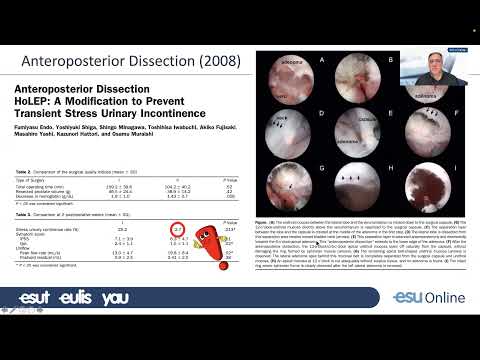
- its functionality so the first technique that was uh published in 2008 by endo was this anterior posterior dissection uh hollap it uh this technique started at 12 o'clock let's say to dissect downwards so it was very different from the original dissection and as you can see there was a amazing improvement in the rate of stress incontinence after the operation it was a relatively small series comparing their results with the classic technique but uh again it was largely ignored not not it didn't have a lot of impact and people got i mean still were obsessed with the three lobe technique then thomas hermann described tulep in 2009 up to that time the thulium vapor innucleation was trying to take out three lobes but many
- times not following the right plane and not always anatomically but tulip used a mechanical dissection with the scope and it used a laser to cut fibrous tracts and to coagulate and they described let's say the basis of a three-lobe education technique carried out with thulium they published a meta-analysis of randomized controlled trials comparing it to hormum and they had a little bit less incontinence rate but still significant and here you can see again the mucosal curtain that we are discussing then dr gong published his uh posterior star technique so instead of starting at the bladder neck preparing incisions he would start dissecting at the apex and then he would carry the posterior dissection all the
- way to the other neck i think this was quite interesting and but i thought it was a little bit crazy because in the large glance that might be a little bit difficult and then he would do a two-lobe nucleation trying to follow again a similar method of dissection anterior the posterior anterior dissection of the of the apex so interesting uh contribution then uh mirnake presented the three-horse shoe-like incision in 2018 and here he was also starting with uh with this dissection uh around the vera montanum to find the plane and he would carry up the dissection naturally again blindly so here you can see the infamous mucosal curtain again and then he would do another horseshoe incision in the battery neck to to
- finalize the procedure and and dissect the prostate uh this this way so an unblocked technique with three incisions but still the dissection of the apex was following the classic approach and also the the incontinence results were similar we described in 2014 this green light enucleation technique it was very similar to hiraoka's original description but we reflected about this white line if you cut the mucosa at the apex before you start the operation you're going to prevent it from breaking in in another area when you do your dissection of the apex and we observed very low uh stress incontinence rate despite carrying out a mechanical enucleation of the prostate and this has been corroborated by many groups who have
- published their series of green light in nucleation the rate of incontinence is very low and that's quite interesting of course uh scofone presented the block note touch technique in 2015.
- it was an unblock technique but it started with an incision a classic incision and then it would try to remove the the prostate and block but again you see the the the infamous mucosal curtain in in one of these graphs so again as you can see people have been trying to contribute with different ideas and we have been evolving uh slowly trying to improve what we do the inbloc technique with one lobe was probably faster it was had some advantages and uh the the no touch technique was a new concept that you should avoid touching the technique with the with the the laser and uh here uh in 2019 scofone reflected even further about uh how to perform the apical dissection to preserve the mucosa in the sphincter
- because uh we are now recognizing how important this is if you want to get immediate continence for the majority of your patients one year before that we published this unblock technique of holmium with early apical release which was a continuation for us of what we were doing with the green light nucleation of course we had to adapt and develop some ideas and tips and tricks to use a straight firing fiber to do the end block technique and we found out that it was a very fast technique with very low rate of stress incontinence and it keeps getting better this is a series of 80 patients that we followed up prospectively with moses holmium and we found out that the rate of stress incontinence was
- very very low after one month thomas hermann published the tulip updated technique in 2019 and uh of course this shows a new development of or an evolution and different reflections on on how to tulip uses a blunt anatomical dissection and it denies the importance of the energy source it's more an anatomical concept then uh this uh technique uh by ito uh the completing block uh with direct bladder neck incision uh technique what they do is they find the plane at the apex and then they progress very fast to the bladder neck and then they continue the dissection clockwise until there they cut the last attachment laterally and they have also uh reported relatively uh lower rates of uh stress incontinence
- rate but this is just showing how vibrant this this field is in neurology that there's new ideas coming up all the time and again this publication by lin also compares different and block and block ideas and they they look at the incontinence rate and they find that three incisions uh with some modification from the other technique that we discussed before where they score the mucosa at the beginning will give very low incontinence rate so they recognize that this technique is very similar to what we described with the white line and the early apical liberation and finally there's a new concept that thomas hermann is pushing the preservation of the 12 o'clock mucosa there is some anatomical background to this with
- techniques that have been described for a robotic adenomectomy where the urethra is preserved so inspired by this thomas hermann has described this idea but we still don't know if it has any advantage in terms of continence or bladder neck structure rates but of course we are exploring new ideas all the time so to me the idea that is showing in different papers different groups and their data is that if you do a careful apical dissection and you try to preserve the sphincters mucosa you will get low rate of early stress incontinence so as you have seen there's many contributions trying to improve the outcomes of endoscopic nucleation there is recent surgical technique refinements that make endoscopic
- inhibition of the prostate a very attractive option for the treatment of bph and i think now it's the time to learn and do it i have personally uploaded more than 30 real time videos real life cases which means that they're not so cherry picked you know that when you see them you find them they're perfect but they they reflect the reality of the technique we described in the early apical liberation so if you're interested i would be very happy if you visit and comment on this on these ideas so thank you very much for your intention and i will be happy to answer questions when the time comes thank you