
Surgery
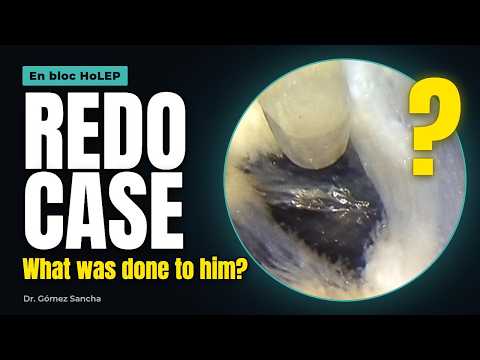
Redo case: what was done to this patient before?
Dr. Fernando Gómez Sancha · ICUA
Dr. Fernando Gómez Sancha · YouTube
Language: English. YouTube audio metadata.
Surgical content for professionals. Contains footage of an operation.
Playback connects to YouTube. Your search query is not sent to the player.
About this video
A reoperation for persistent urinary symptoms after an earlier procedure for benign prostatic hyperplasia. The published description documents retrotrigonal tissue damage and retreatment with anatomical en-bloc laser enucleation (HoLEP). It does not identify the previous procedure or report postoperative outcomes.
What the recording addresses
The written source identifies endoscopic assessment of a previously treated prostate, retrotrigonal tissue destruction and anatomical en-bloc retreatment. The earlier treatment is posed as a question for the viewer and is not named in the published description.
Documented details and sources
Only details explicitly stated in the sources. Missing information does not mean it did not occur.
- En bloc
• How we complete the retreatment with anatomical en-bloc laser enucleation (HoLEP)
- Redo surgery
Redo case: what was done to this patient before?
- Previous retrotrigonal injury
Significant retrotrigonal tissue destruction from the prior procedure
Source checked: 2026-10-06.
Available transcript · English
Automatic YouTube captions, not clinically reviewed. Names, technical terms and numbers may contain errors. Check them against the video; complete audio coverage has not been verified.
Selected spellings of enucleation, morcellation and holmium terms have been edited. This is not a full audio or clinical review; the original captions remain the source.
They may contain transcription or translation errors; check the explanation in the video.
- Hi, this is Fernando Mesancha again with another interesting case I found. Um, and um, I was I was thinking if I should say what treatment was done to this patient before this operation. He had a treatment somewhere and for the following months he didn't pee very well. He was not very happy with the result of the operation. And I would like you to guess what treatment was made to this patient that left a retroronal cavity under the trione. removed
- um a lot of adenoma you know remained with an open bladder neck and preserved um aical tissue that is behaving obstructed. To me the worry was you know what happened here? What happened here? What was causing that uh retrotrional cavitation like that? Uh that could have ended very very close to the urethral orififices. Apparently he had no kidney issues. But um look at that. It's very impressive. And um initially the patient didn't remember the name of the operation that he has had. And uh so we we decided to go in and have a look. Uh he was not being well.
- And you can see there was this obstructive aical remnant that was probably making his his his mutation difficult and obstructive. But uh it's a guess. It's a guess. Let's uh let's see what you think. I would like you to think about it during the video and I will tell you what he had at the end and maybe we can comment uh a little bit here. What I'm doing is trying to discern now where's the limit of the sphincter. You can see the ver is nearby. So I wanted to mark a limit uh that is close enough to the sphincter maybe. Yeah, we we we want to preserve the sphincter of course but we want to remove all the epical
- all the aical um tissue that is obstructive. This case the differentiation between sphincter and aex was not so clear. So yeah, you do your best of course trying to be careful. Uh due to the position of the veto, I think it was a relatively safe uh line to mark, but um of course um uh sometimes it's it's it's a little bit more difficult and then you have to probably enter the plane a little bit and see where is the edge of the alenoma taking you to try to mark that line. most most times I think it's possible to to do a reasonably close to the sphincter line that is uh preserving the sphincter and the rest is
- the same here I did um an entry I did an entry I was checking there that this transparency was not the capsule but the the you see the opened opened cavity there so in this case I I cut that uh but the progression of of the end block enucleation of the renmans would would be performed as usual. So I guess you're wondering maybe you have a response already. What did this patient have? What was the treatment that he was administered? And how come these cavities were created? So we considered different alternatives. You know, we considered
- would have this been um accumulation because the epics is preserved or could it have been uh resum you know and uh of course the RSM theory seemed to be the the right uh guess and when we said resum to the patient he said yes yes yes that's what that's what I had you know he couldn't explain very well what he had in his country when when he came to visit us because he was not being very well. So, uh we we decided to do a systocopy and we had the consent of the patient to act upon the findings to to try to improve his situation. So, here this is the 12:00 tissue here. I considered that maybe my line was too careful and corrected it uh a little bit. And then
- we're going to do the ascending [snorts] uh progressive dissection towards 12:00. Trying to be careful, trying to mobilize enough to to have a nice generate space enough so that we can get to the 12:00 without uh damaging the the sphincter. So this is the the white line. First I deep deepen the white line a little bit and um and so I don't have personal experience with resum. I have treated a number of patients that were submitted to resum and I think that uh it's a technique that were for some patients. Of course it works very well. It produces a good cavitation. It um preserves [snorts] the educator mechanism for for a good number of patients.
- And it's a cavitating technique. So cavitating techniques tend to tend to work better than non non- cavitating techniques. And um but there is some um difficult to predict pattern of uh you know dispersion of of of the heat and the vapor and the necrotic effect that [snorts] could explain uh cases like this. So um so I thought it was interesting to show the case and to show how um this effect can be seen sometimes know that the vapor goes a little bit further than expected and um well show you how we solve this this case in the sense that you had a
- significant amount of tissue at the apex. There's always more tissue than one thinks. When you see the initial systocopy, you might think that there was not so much tissue, but then as you start digging a little bit uh following the capsular level, you realize that there's a significant amount of tissue uh left. So hopefully for this patient, the the problem will be finished. And um it was a little scary to see the amount of destruction of the retroonal uh tissue and um how close it got to the urethral orififices that might have changed the picture completely. Now in this case the patient um couldn't be very well but
- then nothing else uh happened. So and uh also I want to reflect on the you know universality of the unblock technique. Now when you when you when you do a block it is an amazing uh technique that allows you to do every case. You know, it's a universal technique and you can do it especially good especially good for redo cases where you know you start at the apex you explore the plane and despite the aarent you know anatomy remaining after whatever treatment he had TRP uh green vapress whatever you know um you can find the plane you can find the landmarks you can progress safely towards the bladder neck you detach the
- sphincter early so that it doesn't suffer and um you know I think it would be much more confusing to have to do incisions from the bladder and neck towards this aical area. So I think it is worth learning to to do and block because it's a it's a joy of operation and it's also relatively fast. You see that it allows you to work nearly continuously. Now you we do brief stops for for orientation and then you know once you have your lines uh working it's just a matter of oscillating from side to side carefully using the energy very very carefully so that it doesn't um so that it's impossible that this energy pass will cause a perforation. You know maybe when you use the energy so gently
- you are probing you know you are exploring the plane [snorts] and um if if there is a a perforation an initiation of a perforation you have time to correct your aiming in order to avoid going too deep. Okay this is a desired perforation here we want to perforate a connection to the bladder. So in these cases when when I find fibrous tissue many times I contact the fiber with the tissue in order to get the most possible disruptive effect with dissection. But for the rest of the dissection, I try to keep my my fiber at a distance that provides very very careful uh very very subtle uh dissection that doesn't risk you know um going too deep uh in a single pass.
- So um there we are. This is the the connection near the bladder neck already. And uh it was a I don't know 10 10 minutes 15 minutes uh solution for for this man and um a very effective way of um solving the the obstructive problem. No. So to me there's a there's a lot of controversy regarding minimally invasive treatments and it's a very big worry that many of the papers are sponsored by industry and industry influences how the paper is
- designed how the the conclusions are studied and how how the data is presented and um so we need to be very very critical when we read papers about mists because there's a lot of confounding factors and sometimes the conclusions of the studies are not uh supported by by the evidence presented. So, but of course they they have a role and they have to be performed responsibly I think and uh with a very motivated and selected patients who are well aware of the limitations and and um there we are. There's still a little pedicle near the bladder neck. So I will position the fiber at 12:00 to
- lift a little bit the piece while uh performing the last detachment. So it would be interesting to uh read your comments if you want and u uh I will keep posting interesting cases to the channel. you know, it takes a little while to sit down to edit, and it's usually on Saturdays and Sundays, and my wife uh you know, I have to negotiate uh my time uh working during the weekends to to be able to show you this video. So, I hope you understand that. Um many many people write me asking me to post more but um there's a limit to to what I can do but there it is. I will try to select cases
- that are interesting and give you um something to take with you you know and maybe inspire uh people who who don't do inuclation to start doing it. It's one of the best uh operations you can learn today because it allows you to treat the majority of patients u with BPH with excellent results, excellent durability and um in in opposition to to the evidence presented by by mists I think there's uh much less industry influence and uh there is uh you know good good data to support the the the the use of of a nucleation. I think it's the evolution
- of after uh TRP of of endoscopic um uh the treatment of BPH and I think um it's worth it's worth learning every every department I think today should be able to offer a nucleation to the patients. Here I am changing the cystoscope for the nephoscope. You can see we try to do a fast change and now trying to morelate the the little piece this little piece probably I don't know five six seven g of tissue that uh we're obstructing the apex and making this patient unhappy and hopefully he will be okay for the rest of his life and he will be able to to pass water comfortably and the little problem that he experiience
- Ed uh after resumm will be will be definitively solved. So let me know what you think in your comments and uh see you around and I hope you enjoyed this uh fast case and um it will help you recognize because I had to say at the beginning I didn't really know what had happened. You know sometimes we see these posterior cavities after um radical procedtomy when there is a hematoma. Sometimes the anastmosis breaks and we see that kind of posterior diverticulum there. Uh okay enjoy uh all the best. See you around. Bye-bye.