
Surgery
En Bloc HoLEP post-TURP
Dr. Fernando Gómez Sancha · ICUA
Dr. Fernando Gómez Sancha · YouTube
Language: English. YouTube audio metadata.
Surgical content for professionals. Contains footage of an operation.
Playback connects to YouTube. Your search query is not sent to the player.
About this video
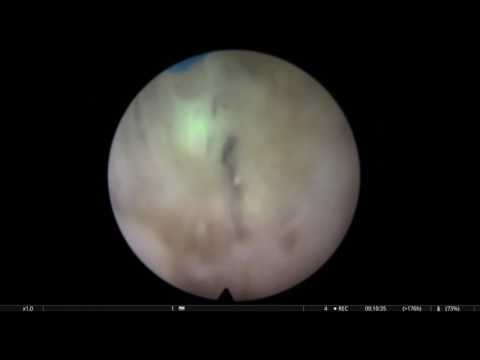
An en-bloc HoLEP after an earlier TURP that had not resolved the patient's problem. The recording demonstrates the approach in previously treated anatomy. The description does not identify the cause of the earlier treatment failure or report the later postoperative result.
Documented details and sources
Only details explicitly stated in the sources. Missing information does not mean it did not occur.
- En bloc
En Bloc HoLEP post-TURP
- After TURP
En Bloc HoLEP post-TURP
Source checked: 2026-10-06.
Available transcript · English
Automatic YouTube captions, not clinically reviewed. Names, technical terms and numbers may contain errors. Check them against the video; complete audio coverage has not been verified.
They may contain transcription or translation errors; check the explanation in the video.
- hello this is phenomena from the ICU a technic Center in Madrid Spain commenting on this case and in brach Halep after failed T or P T or B is considered by many the gold standard for surgical treatment of BPH but in my opinion it's hardly ever complete in the sense that after T were being most patients would still have no much a sticker that can grow with time and lead to reoperation in this case as you have seen there was a cynic here in the in the prostatic urethra and the patient was still obstructed and bothered by
- hips in his symptoms he developed a bladder stone that was very easily removed with after fragmenting it with home laser and evacuated from from the bladder and in this case it's very interesting that home young laser is a good option for retreatment due to the fact that the plane of dissection between the Noma and the surgical capsule is easy to develop even when there has been a previous T or P so that's the last part of the stone coming
- out by gravity emptying the bladder and as you can see that's the cynic here that's a very montana to lateral lobes and finally the sphincter what I'm going to describe in this video is an N block technique that I am loving so much lately because it is extremely elegant and I think it protects the sphincter much better than the classic polyp techniques some people think that in block a nucleation is going to carry a higher risk of incontinence but I think it's the opposite I think that if you start interiorly like this developing an
- incision between the sphincter and the apex and dearly like that this is going to be very very good for protecting the sphincter now you can see that the sphincter limit is well marked and I'd like to walk to mark this white line all around the apex and my objective is going to be to try to release the apex from the sphincter as soon as possible as you can see it's important to do a single white line and then respect the limit you see this initial work creates a groove in the prostate where the resync to scope is going to fall naturally and then of course it's a
- visual landmark that you can set in your operation to know where is the limit of the center but also it's a mechanical landmark in the sense that when you're working at the apex the tip of the scope is naturally going to get into that groove protectingly the sphincter you see there has been a groove that goes all around the apex following this white line and demarcating the lower limit of our operation I like to combine the mechanical dissection moves you see the tip of the scope allows us to to do this to dissect the plane mechanically and many times is
- very useful to make sure that we are in the proper plane when it is not obvious from the endoscopic view especially after using some energy so I would say that I don't agree with idea of doing a no touch technique or for nucleation because I think mechanical movements can be very very good for discovering where the plane is and to help in the dissection of the proper plane yes as you can see I have also cut the crystal with rallies to develop the posterior aspect of the plane between the Anoma and the prostate so you see how fast on
- the beginning of the operation the landmarks are set after this point I like to have the fiber more at 12 o'clock as it is easier to work towards the interior part of the prostate with the fiber in this position at 12 o'clock so as you can see I'm very very careful trying to preserve what is above in the white line so you have to very carefully dissect the Innova from the gland you see that the home iam energy is opening up the plane and at the same time is providing with homeostasis so it fulfills this double purpose of performing hemostats isn't opening the
- plane but also we have to be very very cautious to respect everything that is interior which is still this venture here we are reaching the the landmark at 12 o clock the place where we marked the the limits of this victor at 12 o clock and you can see that even when the patient has had a tea or pee the dissection of this plane is quite straightforward because energy never reached there that's crossing over a little bit to the other side to the right side of the patient but here what I'm doing is to do an initial liberation of the apex I'm trying to start the operation by liberating the apex completely from the center the
- this will avoid the pudding sphincter and you'll see that once the apex is totally released from the surgical capsule the rest of the operation is really really simple I think this approach has some advantages over classical approach approaches where the incisions on the prostate were made to to remove let's say nope by law the the prostatic adenoma here you see that now this side let's say of the apex of the prostate has been released and I'm working to dissect this plane one of the
- nice things of doing an unblocked operation is that the space where we were working is quite limited so the flow of water is going to flush very efficiently any amount of blood that goes into this space which means that we will have good visibility all along the operation okay that's one side now we go to the other side this is where we marked the white line and the lower plane of course if there is any vessel leads during the operation is better to tackle it while you're doing the oppression I'm not wait to the end to do hemostasis here you can see the white line and how carefully I'm climbing up
- trying to respect what is anterior try to respect the sphincter above the fiber at this exact moment so again the idea is to climb up here I'm using a little bit of mechanical dissection sometimes mechanical dissection liberates this part of the prostate easier than the energy this is something that comes with experience and as I said there is no sin in using some mechanical dissection many times it's extremely helpful here you see that's the apical part and again we are respecting this white line and respecting what is anterior to that but then it's important to follow the plane all the way up because we want to make
- sure that we're not living tissue anteriorly after we after we release the sphincter huh so what's the idea climbing up trying to be very conscious of where we are in relation to the sphincter and in relation to the white line or some no matters nodules are the apex in this this point but I had to remove but you see that we have been operating for ten minutes including the removal of the stone and almost the apical part is completely freed I will be happy when I'm able to cross let's say from one side to the other side a
- trophic LOC and I see that this fix is completely free and the sphincter has no longer attachments to the apical part of the prostate so there we are as you can see another advantage of this unblock approach is that once the apex has been released following the plane following the line is very easy because you have a very very long line of attack very uniform and it is in my opinion much easier to stay in the right plane when you have this this circumferential line of attack and this amazing disability when you remove one lobe and
- then the homeostasis and then move on to remove another log there is some blood in the cavity that you are starting to do to generate whereas here as you can see we have very nice disability and also you can you can realize that the posting time is reduced with these good visibility and with this clear line of attack you can almost work continuously with your laser to develop the plane so the stopping time in the operation is greatly reduced which means that we will be able to complete this operation in a very very short time which i think is
- another advantage of this block inhalation it takes I guess less time to do a prostatectomy in this kind of operation as you see the sphincter is now totally free and released from the apex so even when we have to do big movements around the adenoma even in big enormous the sphincter is going to follow with the the scope because there's a lot of mobility of the sphincter and it will not be stretched it will not be stretched there you see that the work is continuing very fast the claim is being developed I tried to keep the fiber pointing a little bit
- more towards the side of the head nama because this allows to have a mild let's say coagulation effect on the on the other side and it reduces the possibility of perforation in there in the prostate if there is some let's say deepening in the capsule it's very easy to correct their trajectory but as you can see I'm trying to circumferentially touch their normal us as I work try to make it a uniform line and there we will try to find the access to the bladder neck it's important to remember that the contour of the prostate is
- more or less spherical which means that once we have climbed over the top part of the Anoma the bladder neck is going to be a little bit lower down so in the same way when we are working here in the lower part of the posting and posterior aspect we cannot continue cutting straight because this would take us out of the prostate we have to know that we have to cut a liquid further up here we were lucky enough to enter the bladder at 6 o'clock usually I would try to enter the bladder a little bit further up you see us I prefer to enter anteriorly but in this case the plane led us directly to enter
- the batter at 6 o'clock that's the interior part you see there's still some Dutchman's I'm trying to release if there's any bleeder of course it needs to be controlled because if you do a good progressive hem stances as you work with the laser you will not need to do much Hema status at the end when you have to switch to more sedation so it is really saving time to stop a little bit and don't get carried away with let's say advancing with a procedure here that's a linear tissue and that's the access to the better knife you can see that the access to the latter neck lays a little bit low
- so once you have climbed the the higher aspect of the Anoma you have to to lower the aim of your laser as you approach the bladder neck as you can see it's a matter of continuing the release and following the principles the principles would be to stay in the right plane and to do good hemostasis as you go points the fibre towards there normally with more towards the capsule so if you cut something it's better to cut into the end no more than to cut into that capsule and keep a good visibility so you can
- continue working at nice at a nice pace you see it's been 16 minutes of operation now and most of the prostate is detached from the attachment to the surgical capsule and we are approaching the bladder neck circumferentially that's near the bladder neck cutting the mucosa of course there are some nasty vessels around here that sometimes need a little bit of attention for this operation I was using a 50 watt Auriga XL volume laser from Boston Scientific she's the one we use in in Sofia
- Bulgaria when we do for me laser and as you can see even working at relatively low power thing is 34 watts or something like that we can have very nice oyster season - the attachment of the ID number here I'm checking on the us usually the initial inspection will tell you where the uos are in relation to the bladder neck and they will help devising a strategy to protect them let's again ladder neck being cut and there is some decimal we need to look lies you see this kind of bleeding it's important to realize that there is a decimal let's say pouring blood against your lens but
- it's in no way a severe bleeding usually you just have to be patient - to cry with it and as you can see now most of the I promise mobile there's still some some attachment small vessel needs combination but I think now the aroma has been released circumstantially and now it's being pushed into the lair you see 17 minutes and 45 seconds took to remove this this adenoma it's not a large prostate but you can see the quality of the preservation of the sphincter basically we marked our white line and there's no mucosal damage below the white line which i think is very
- important for post-operative continents the patients will have earlier continents I think if the totality of the mucosa of the sphincter is preserved you know that the mucosal seal is very important for continents and I suspect that the high rates of stress urinary incontinence found in different groups experiences with Romeo later are due to the fact that one day they dissect the apex they don't say do any effort to preserve this mikasa and many times they're finishing the 12 o'clock liberation there's only a strip of mokou-san remaining in the structure but the rest of the sphincter has been denigrated
- completely so that's why I see a merit in preserving this this mucosal so this is the final hemostasis before switching to more solution of the tissue if you are more careful with M stances as you go I was working that's a relatively fast in this case you have to find a good balance between let's say working fast and progressing fast and having a good hemostasis in this case it was not too bad of course once the Nama is removed from this cavity there is no longer such beautiful visibility yes
- when we have this very very small space to irrigate here there's more counting flow and if there's some bleeding quality of the visibility would be a little bit less but again that's the beautiful preserved sphincter and I think in no time we're going to change the instrument to proceed to more select it's again how you have to review and avoid a major major bleeding there's a little bit of losing or blood that you cannot let say you can stop sometimes but the major bleeders have to be stopped otherwise visibility could be bad in during oscillation
- that's a capsular bleeder that needs some attention in my opinion they won't have what home later it's probably better for coagulating big big vessels but usually there's not so much problem with this lower power laser to coagulate vessels and either is we do a fast switch to reset the scope to coagulate the upper the bleeding point and then go back to there to the laser again this is the change changing the laser sister
- scope for a nephron scope or more scope that will help me introduce the blades and my nurse is helping me to do the change of instrument there you go we don't want to decompress the bladder and to have more bleeding starting so we have a reasonable visibility and I'm going to input the modulation modulation blades or this is a piranha system with a single-use fast blades that provide a very very fast modulation it's been 22 minutes now from the beginning of the operation and we start the modulation of the remaining tissue that was left after TRP
- I probably grew over time and produced lower urinary tract symptoms again I think T where P is overrated I think and the scopic innovation of the prostate is a much better procedure to provide a long term result to patients who want to get rid of their urinary symptoms due to BPH as you can see these morcellator it's very safe I'd like to see the wolf logo on the blade which means that you have to push the blade quite inside the bladder and and then come close to the bladder neck if you look if you look at the lower aspect of the image you can
- see that I can see a little bit of bladder neck in both sides so I know that I am with my blade right above the triangle and I keep it very static so there is no danger to - to the bladder there is the most elation finished and the still that we'll be losing but the catheter will stop that and the procedure has finished thank you very much for your attention