
For patients
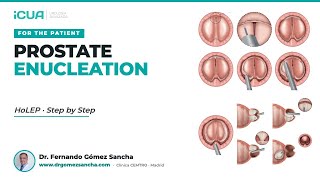
HoLEP Surgery Step by Step
Dr. Fernando Gómez Sancha · ICUA
Dr. Fernando Gómez Sancha · YouTube
Language: English. Editorial classification in the patient catalog.
Playback connects to YouTube. Your search query is not sent to the player.
About this video
In this video, Dr. Fernando Gómez Sancha — urologist with 32+ years of experience and over 10,000 prostate laser surgeries — explains step by step how HoLEP surgery is performed.
🔹 Patient preparation
🔹 How the holmium laser works
🔹 The en bloc enucleation technique
🔹 Recovery and expected results
Documented details and sources
Only details explicitly stated in the sources. Missing information does not mean it did not occur.
No clinical case details have been extracted for this video.
Original title and description on YouTubeSource checked: 2026-10-04.
Available transcript · English
Automatic YouTube captions; they may contain errors.
They may contain transcription or translation errors; check the explanation in the video.
- Doctor, what exactly is the operation like? This is the question patients ask me most when I suggest surgery using holmium laser enucleation of a prostate. And it makes perfect sense. You're trusting a surgeon with your body, so you deserve to know step-by-step what will happen. I'll explain it today.
- I'm Dr. Fernando Gomez Sancha. I've performed over 10,000 laser prostate enucleations, operated in more than 50 countries, and trained over 600 [music] urologists in this technique.
- What I'm going to tell you is exactly what I tell my patients in the clinic. Before surgery, HoLEP is done with spinal anesthesia. It's an injection in the back that numbs the body from the waist down. You're awake, but quite sedated, relaxed.
- There are no cuts, no external incisions. Everything's done naturally through the urethra where you normally urinate. The operation itself [music] involves [snorts] inserting an endoscope, a thin tube with a camera and a working channel, through the urethra to the prostate.
- There, we use a very modern holmium laser, which has a fiber that emits very precise energy. With that laser, we separate the enlarged prostate tissue, the benign tumor inside the prostate, from the surrounding capsule.
- It's easy to imagine it like peeling an orange. The capsule is the orange peel, and the tissue that grows and obstructs the prostate is the pulp. We separate the pulp from the peel, leaving the urinary canal completely open.
- The technique I described is called en bloc enucleation with early apical release and preservation of the sphincter mucosa. And what does that mean? Instead of cutting that tissue, those segments of the tangerine, into fragments, [music] right lobe, left lobe, middle lobe, I enucleate the whole prostate in one piece, as if you [music] were removing the whole orange, in a single movement.
- Why en bloc? Because it's much more efficient, the [music] surgery is faster, the patient bleeds less, and above all, it greatly reduces the risk of temporary stress incontinence >> [music] >> that some patients experience postoperatively.
- Once we've freed all that tissue and moved it into the bladder, we perform the morcellation process. [music] The morcellator is a tissue aspirator that chops it up and sucks it out.
- All this tissue is then sent to the laboratory for analysis. The duration of surgery for a medium-sized prostate, >> [music] >> between 60 and 80 g, is between 25 and 40 minutes. For large prostates of 150, 200 g or more, it can take a bit longer, around an hour or an hour and a half.
- But HoLEP is precisely the technique that best handles large-size prostates. I've operated on prostates of over 500 g using this technique. After surgery, you leave the operating theater with a catheter inserted through the urethra into the bladder.
- In most cases, this catheter is removed the following day. Many patients can go home on the same day or the day after the operation. For the first few days, you might notice a bit of urinary urgency, some blood in the urine. [music] It's completely normal. It's the healing process taking place in that wound we've left inside the prostate.
- When do you get back to normal? Most of my patients resume their normal activity very quickly, but you shouldn't do intense physical exertion for a month, nor [music] have sexual relations, but walking, working in the office, daily life after three or four or five days is possible.
- Regarding complications, in more than 10,000 procedures, the rate of serious complications is very low. It's less than 1%. The most frequent complication, which technically isn't a complication, but an expected consequence, is inward retrograde ejaculation, which I'll talk about in another video.
- What I want you to take away is this. HoLEP is a minimally invasive surgery without cuts that removes all the prostate tissue that's obstructing the flow of urine permanently. The long-term reoperation rate is very low, less than [music] 2%, and that means that for most men, it means a definitive treatment. The problem is resolved forever.
- If you want to know if HoLEP affects erections, I'll [music] give you a spoiler. It doesn't affect erections. Watch the next video. Subscribe, so you don't miss it.