
Professional education
En Bloc HoLEP with Early Apical Release — The Gómez Sancha Technique (WJU 2019)
Dr. Fernando Gómez Sancha · ICUA
Dr. Fernando Gómez Sancha · YouTube
Language: English. YouTube audio metadata.
Professional education. May contain surgical footage.
Playback connects to YouTube. Your search query is not sent to the player.
About this video
Based on automatic YouTube captions; not clinically reviewed. Check technical details against the video.
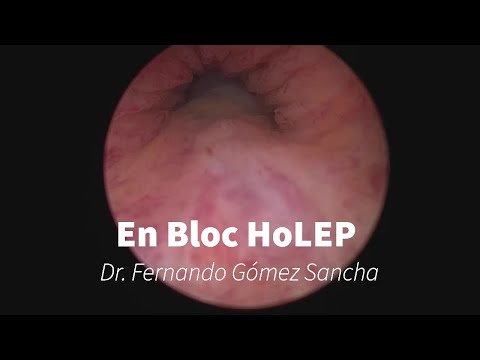
A narrated demonstration of en-bloc HoLEP with early apical release. The automatic captions explain how the white line is used as an anatomical reference and how the surgeon connects the dissection on both sides. Later passages discuss following the adenoma contour and adapting laser aiming when the capsule becomes thin around nodular tissue.
The white line and apical release
The commentary follows the initial marking, progressive mobilisation of the apex and connection of the two sides. Preservation of the sphincter mucosa is the stated technical aim; this recording does not supply a measured continence outcome.
Adapting to the plane
The surgeon describes maintaining a broad line of dissection rather than advancing deeply in a small isolated area. The discussion of nodular growth distinguishes recognising a thin capsule and changing the aim from reporting a perforation as an actual complication.
Documented details and sources
Only details explicitly stated in the sources. Missing information does not mean it did not occur.
- En bloc
En Bloc HoLEP with Early Apical Release — The Gómez Sancha Technique (WJU 2019)
- Early apical release
En Bloc HoLEP with Early Apical Release — The Gómez Sancha Technique (WJU 2019)
Source checked: 2026-10-06.
Available transcript · English
Automatic YouTube captions, not clinically reviewed. Names, technical terms and numbers may contain errors. Check them against the video; complete audio coverage has not been verified.
They may contain transcription or translation errors; check the explanation in the video.
- hello this is phenomenal in sanchow I'm going to show you a case I did yesterday this is a man with a relatively bulky prostate ultrasound estimation was 90 grams using an abdominal ultrasound maybe a little bit smaller as ultrasound tends to overestimate prostatic sizes but I'm going to show you the in block technique it's very beautiful it's amazingly fast and I think it's going to change the way we see home you a nucleation of the prostate so there you can see the sphincter I try to mark the mucosa and create this line what I call
- it light line in intimate contact with the sphincter edge I don't like to go inwards I don't like to some millimeters inside because this is this is where you have to touch the sphincter right at the edge as you can see this is an asymmetry call apex so in one side there is more Bock than you the other side but I try to stay as I said close to the sphincter and limited this white line which is going to serve as a reference for the rest of the procedure I'm using a holmium 100 watts laser in this case I'm
- not using the new Moses effect the new Moses system and the settings are 2 joules and 50 yards so it's important to deepen a little bit this white line see you can see the sphincter edge and initially we're going to make the lower parts liberation so I'm going to cut you see this attachment of the apex to the sphincter in the lower part trying to get off let's say 2 3 o'clock because we will do the liberation of the lower parts initially and I don't want to break the the sphincter here it's it's quite liberating already now I'm going to
- enter mechanically into the plane at the apex I found this very fast and very convenient see that's how I enter the plane between the Anoma and the surgical capsule just with the tip of the scope I have a special scope from Richard Wolff that allows for this mechanical bisection very very gently but this is more or less all of the mechanical dissection I will do here I'm just cutting on top of this very Montana to join the planes in both sides and then I will position the fiber at 12 o'clock
- here I'm checking that the liberation of this fibers at the LDH is complete because we don't want to do to break the sphincter spoke OSA so now for the remainder of the procedure I'm going to keep my favorite 12 o'clock and I will not rotate it I think it's important to make this operation simple and having to rotate the fiber having to rotate usually confuses more than it helps in my opinion so I like to keep it at 12 and work with the camera fixed at 12 and
- the fiber fix at 12 okay so I like to do posterior dissection initially take it a little bit into the into the prostate in the direction of the lateral neck without taking it too far just let's say dissect what is possible to dissect in this canopy in this case the plane is not very beautiful but there I go I think this saves a lot of time make separation much faster and you have to be always aware that there might be nodular growths that are growing inside
- the capsule so always looking for that for the good plane but also keeping an eye on the possibility of nodules that grow pushing the capsule and compressing it and you see now when we go back the apex has been liberated until 3 and 9 so all the lower part of the apex has been liberated ok and this is the trick I have to go now and cut into the prostate following this white line keeping the fiber horizontal especially at the 12 o'clock area from from 11 to 1 and then once you have let's say it touched the
- prostatic apex from the sphincter by doing this cut then you can go and look for the proper plane many people think if you cut into the prostate you're going to miss the plane ok no the idea is this cut will let's say liberate the center from the apex then afterwards afterwards this is the let's say 12 o'clock position this is the other side here I can see you see the white line what I'm doing is cutting into the prostate first a little bit just 3 4 millimeters in depth you can see now that the prostate it touches from the sphincter a little bit and then you see this would be a wrong plane but I'm not concerned at this now because I will go
- to look for the good plane you see once I have cut four millimeters into the prostate five millimeters into the prostate following the white line keeping the fibre horizontal at the two o'clock area what I have done is I have detached the sphincter from the apex here still you see you have to follow this curve that we marked initially bring it up slowly don't hesitate to cut a little bit into the adenoma you see that's the mucosal edge at 12 o'clock and then this allows you to go again into the right plane and look for day for the right plane to go all the way and TDR this is what I call the
- early ethical deliberation which means that we're going to liberate the apex right at the beginning of the procedure and why is that important I think when you liberate the epics completely at the beginning of the procedure you stop worrying about the sphincter and also I think that this limits distinction and traction of the sphincter here you see you the attack to the today to the ethical liberation has to go from the lower part coming up and then see if you can join from both sides in the midline at 12 o´clock okay the important thing is to to know that once you deepen this
- white line you are let's say working a little bit far away from the sink there now and you can see that we will be able to preserve the whole mucosal lining of the sphincter which I think it's very important to preserve continents so here you can see that now you progress a little bit following the the right plane trying to come up trying to come up but twelve o'clock and let's say join the dissection on both sides this is the trickiest part of the operation this is the let's say the part of the operation
- that can take longer maybe ten minutes or so and then once the sphincter is totally liberated the rest of the procedure is a piece of cake is very easy we have many advantages of this approach one is that as you can see we are only irrigating a very small space we are not irrigating into the bladder you see we are developing a space between capsule and adenoma here I think I'm connecting now let's say both planes at 12 o´clock there we also now you have to follow this plane try to go as much up as you can so you don't leave until your tissue but I would say that the
- first consideration here is respecting this winter if there is some interior teacher touch to this painter at the end of the procedure you can always review it and take it out if you were not let's say if you left a little bit of tissue until you reattach this vector as I was saying this space is irrigated and very efficiently because it's very small and if there is bleeding the bleeding is washed out this blood doesn't go to the bladder and stays there as it happens when you do a three low technique or you do incisions in the prostate in a classical way so now you see that the proceed is going to be a piece of cake and extremely fast because we are dissecting this line of attack this line
- of attack look at the sphincter how a beautiful home of course has been preset I'll show it to you later as well but as you can see now the idea is that we can follow all around we have a line of attack that it's going around going around and you just have to follow this line okay instead of going very deep in a very small area what I try to do is to follow this wide line that Orient's you very well and tells you where you are you see the fibers always kept at 12 o clock and you will see that this prostate has some nodular growth in the in the lower part we will see how how to
- do okay so initially the plane has to open because we are dissecting a spherical or nearly spherical adenoma so what I do is at the beginning of the procedure my my targeting of the line you see it's a little bit external so as as I am dissecting the initial part I I need to open up a little bit so my father is going to dissect just firing straight at the attack line you see this way but then of course when we are more than the equator when we are progressing we need to close a little bit we need to get close to the adenoma so my fiber is
- going to fire let's say more close to the ad Noma it's very simple or to two places to fire at the beginning of the procedure you will fire straight at the attack line and as we have to let's say get closer to the Annamma to follow the contour of the prostate and here you can see this is the bladder neck you can tell very easily because the fibers of the latter neck initially are round as you can see but then we find this vertical fibers that in equivocal I tell you that you're going to enter the platter so that's the middle lobe we saw before it's cutting the mucosa anteriorly typically I would dissect the platter neck let's say going down and trying to reach six o'clock they will
- see in this case things turned out a little bit differently but I think it illustrates very well how fast how fast this dissection can be and how easy the good visibility we have because the irrigation this is amazing and how easy it is also to follow the line of attack okay here now we are let's say closing and then in the posterior aspect you see initially we descend it we went to the equator of the of the Anoma and then we have to ascend on here you can see that this is the lateral aspect and now this is the posterior lateral again trying to liberate this this part but you can see
- here a flimsy there the capsule can get when you have a nodule that pushes the capsule and thins it so carefully here we are in danger of let's say perforating but here you have to stay very close to the air to the enema very close you see my fiber and the energy let's say it's mainly hitting the Anoma but the the plane will dissect and there will be some correlation effect on the prostatic capsule so there we are just following this line following this line as I said usually I would continue cutting the bladder neck from anterior to posterior and then I would take both incisions in both sides but take closer
- and closer to the midline until I can liberate the normal but here you'll see that we're going to find there's a very nice middle lobe pockets that dissect very easily and we're going to enter the bladder from the posterior aspect huh this is one of these nodules you see they grow and they thin the capsule but you need to take them out and I think it's it's safer it's very safe if you keep close you see I keep close to the two addition now I don't work now firing and straight at the line of attack but a little bit closer to the adenoma this will dissect this plane even when we are let's say climbing up the retro triangle space sometimes
- there we go so you can see that we entered this pocket this middle of pocket very nicely very beautiful and at some moment I thought okay this is the the MCOs of the bladder let's let's go inside the bladder this is not so common but there we are it was very easy to enter the bladder to cut the mucosa and we had let's say dissected the the anterior part of the bladder neck and now the posterior and now I have to connect in both sides so this would be one of the sides we see now the the prostate is free just hanging from two attachments in both sides here I was trying to go up and see
- but you see the prostate had lifted a little bit it was not so easy to access so it went to the other side interiorly trying to see you see how to connect both both aspects so very easy very fast very easy orientation and I think this is going to become standard way of of doing Halep because it is so fast and also you are so relaxed when you are let's say dissecting the tissue on knowing when the sphincter is perfectly healthy we've seen very very low rates of incontinence and also being able to do
- these prostates in 30 40 25 minutes one hour for the largest cases and one hour and 15 minutes you know it really changes everything the other thing that changes everything is the fast modulation provided by by the reach of all Pyrenean system I think this has changed to our lives but here you see this is the final attachment and I'm going to show you how the sphincter looks at the end of a procedure which I think it's a beauty you can see that it's not even 20 minutes I think when the innovation finishes are not going to show you in Malaysia but there you go that's this thing look at it wonderful preservation all around I hope you liked it