
Professional education
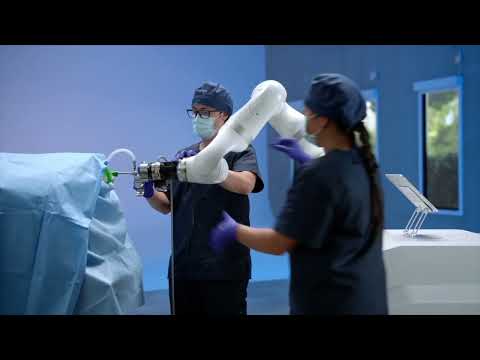
Robotic HoLEP, the Beacon platform from Andromeda Surgical, the future of enucleation?
Dr. Fernando Gómez Sancha · ICUA
Dr. Fernando Gómez Sancha · YouTube
Language: English. YouTube audio metadata.
Professional education. May contain surgical footage.
Playback connects to YouTube. Your search query is not sent to the player.
About this video
A presentation of the Beacon platform for robot-assisted HoLEP, shown at a Society of Robotic Surgery annual meeting. The description says that initial Astra Study results are presented. It characterises the technology as evolving and supplies no numerical study results in the written material.
Documented details and sources
Only details explicitly stated in the sources. Missing information does not mean it did not occur.
No clinical case details have been extracted for this video.
Original title and description on YouTubeSource checked: 2026-10-06.
Available transcript · English
Subtitles exported from the original-language YouTube Studio editor. Not clinically reviewed; source identity and timestamps verified, full audio coverage not verified.
Selected spellings of enucleation, morcellation and holmium terms have been edited. This is not a full audio or clinical review; the original captions remain the source.
They may contain transcription or translation errors; check the explanation in the video.
- Can advances in robotic assisted surgical platforms give more patients access to the very best treatments? This video abstract presents an overview of the beacon platform for robotic assisted HOIP known as rolep and findings from the Astra study an early clinical evaluation of the technology. Holip is considered the gold stand for BPH treatment. Effective, size independent, yet limited in accessibility due to its learning curve and technical demands. Currently, fewer than 10% of eligible patients in the US receive HOAP. It it requires a realtime understanding of prostatic anatomy demanding both spatial awareness and surgical precision.
- The Beacon platform aims to mitigate these challenges through intelligent robotic assistance and integrates into standard O workflows. It features a touchscreen operated robotic arm and interfaces with conventional endouology instruments via proprietary adapters eliminating the need for disposable components. Functionally, the Beacon platform includes a robot cart, a touchscreen tablet interface, and proprietary surgical instrument adapters, including a nucleator adapter, a morcellator adapter, and a morcellate morcellator clip lock.
- All of which support the hole procedure through a unified and userfriendly digital interface. The Astra study is a prospective multic-enter first in human physibility trial assessing the safety of robotic assisted hol using the BCOM platform. 19 patients were enrolled across five study sites with a mean process volume of 56 cases. Each underwent enucleation using the BCOM platform. The primary safety endpoint was the rate of claim dindo grade 3A or higher adverse events within 30 days. confirmed and independently adjudicated by the study's principal investigators. Importantly, no complications grade three or higher occurred. No transfusions, no reoperations, and no lifethreatening events.
- Reported adverse events were consistent with established posttop hol profofiles including transient urgency, dura and temporary incontinence. These events resolve or were improving at follow-up and were not attriutable to the device performance or system design. Procedure duration across all patients average 137 minutes. For the six most recent cases, this was reduced to 89 minutes, which is comparable to published data on manual hole. Software upgrades have improved the performance over time.
- From a clinical perspective, the safety outcomes in Astra align with those observed in conventional HOP supporting the hypothesis that role does not introduce additional risk. From a technological perspective, the Beacon platform is engineered for longevity and adaptability. Its modular softwaredriven design allows for ongoing performance improvements and feature expansion without requiring hardware changes. This includes future integration of advanced decision support tools and higher levels of autonomy while ensuring the surgeon remains in full control. Regulatory submission to the FDA has been completed and the platform is currently under review for 510K clearance. This is a significant milestone in validating the systems readiness for broader
- clinical use. Looking forward, the next phase of the study will build upon the current findings by focusing on comprehensive performance metrics with a larger number of cases. While Astra focuses on HOL, the Beacon platform is designed as a full spectrum endurology system with plans to expand into into other endurology procedures via future software upgrades.
- In summary, Astra has demonstrated that the Beacon platform provides a safe, efficient, and adaptable approach to robotic assisted HOLIP. These findings lay the groundwork for expanded clinical use and continued innovation in robotic endooy.