
For patients
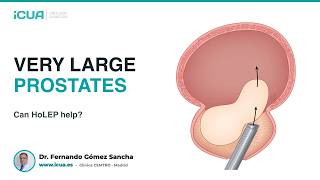
Very large prostates: can they be treated with HoLEP?
Dr. Fernando Gómez Sancha · ICUA
Dr. Fernando Gómez Sancha · YouTube
Language: English. Editorial classification in the patient catalog.
Playback connects to YouTube. Your search query is not sent to the player.
About this video
Have you been told your prostate is too large for laser surgery? I’m Dr Fernando Gómez Sancha, a urologist at ICUA. In this video, I explain how I approach very large prostates with HoLEP and what you should know when considering surgery.
🔹 What a very large prostate means and how it can obstruct urine flow.
🔹 How the adenoma is separated from the capsule during holmium laser enucleation.
🔹 Why the surgeon’s experience matters in these cases.
🔹 Recovery, continence and expectations: how to interpret a clinical series.
You can read our publication on En Bloc HoLEP in 754 patients whom I operated on:
Iscaife A, Rodríguez Socarrás M, Talizin TB, et al. Contemporary results of En Bloc holep for large prostates. World J Urol. 2025;43:401.
Follow-up clarification: the published abstract reports stress urinary incontinence of 0.9% in the larger-prostate group and 0.15% in the smaller-prostate group at six months. These should not be presented as rates of permanent incontinence at one year. The study compares groups using a threshold around 120 g and reflects the experience of one expert surgeon; it does not guarantee an individual outcome.
Documented details and sources
Only details explicitly stated in the sources. Missing information does not mean it did not occur.
No clinical case details have been extracted for this video.
Original title and description on YouTubeSource checked: 2026-10-04.
Video moments
- A 400-gram prostate: does it need open surgery?
- HoLEP: is there a limit to prostate size?
- Prostates over 100 g: our data
- A stream he hadn't had in 15 years
- Large prostate: higher risk of incontinence?
- Very large prostates: can they be treated with HoLEP? · 0:00
- Very large prostates: can they be treated with HoLEP? · 0:45
- Very large prostates: can they be treated with HoLEP? · 1:28
- Very large prostates: can they be treated with HoLEP? · 2:11
- Very large prostates: can they be treated with HoLEP? · 2:50
- Very large prostates: can they be treated with HoLEP? · 3:36
Available transcript · English
Source: subtitles embedded in the published video.
They may contain transcription or translation errors; check the explanation in the video.
- Doctor, I've been told that my prostate weighs one hundred and eighty grams and that it can't be operated on with a laser, that I need open surgery. Well, no, not necessarily. And today I'm going to explain why.
- I'm Doctor Fernando Gomez Sancha, I've been in Urology for thirty-two years and I've performed over ten thousand laser prostate enucleations, including prostates over five hundred grams.
- To give you an idea, a normal prostate weighs about twenty to twenty-five grams. A four hundred gram prostate is sixteen times that, it's like sixteen normal prostates. And with Holmium laser enucleation, it can be operated on in a minimally invasive way.
- What were the traditional operations for very large prostates? Open adenomectomy, a major surgery where an incision was made in the abdomen, the bladder or prostate capsule was opened, and that tissue was removed by hand, that benign tumour which is the prostate adenoma or benign prostatic hyperplasia.
- It works, but it requires several days of hospitalisation. There's a significant risk of bleeding and transfusion, more post-operative pain, and recovery took weeks, and still does in many centres.
- Transurethral resection was effective for small and medium prostates, but for a one hundred and fifty or two hundred gram prostate, it falls short. The surgical time is extended, the risk of complications increases, and the resection is always incomplete.
- What changes with enucleation? Everything changes. Enucleation has no theoretical size limit. The technique is the same for a four hundred gram prostate as it is for a thirty gram one.
- The laser separates the adenoma tissue, the benign tumour that all men have and that grows with age, from the capsule, it separates it, we push it into the bladder and remove it with a tissue aspirator called a morcellator.
- What changes is the morcellation time. It's a little bit longer, because the more tissue there is, the longer it takes us to get it all out. But the enucleation itself is done practically the same way.
- And this is where my technique, en bloc enucleation, with early release of the apex and preserving the sphincter mucosa, has a special advantage. In very large prostates, en bloc enucleation is very efficient, because you work in a continuous anatomical plane, you don't go lobe by lobe.
- You separate the entire adenomatous mass in a single piece. Fewer steps, less bleeding, more control. I'll give you specific data. In our series with prostates over one hundred grams, the average hospital stay is one day.
- One day. The catheter is removed after twenty-four hours in most cases. Serious complications are less than one percent and the functional results, how well or how the patient urinates, are the same as in small prostates.
- What's more, large-sized prostates are my favourite cases. Why? Because the difference for the patient is huge. A man who hadn't slept for years, catheterised, on medication that didn't work, with a flow that was more of a trickle, uh, who leaves the operating room the next day and urinating with a flow he hadn't had for fifteen years, the patient's satisfaction is absolute.
- And the risk of incontinence in experienced hands and in our hands, the risk of permanent incontinence is very rare. Zero point something percent after a year, regardless of the size of the prostate.
- There may be temporary stress incontinence in large prostates. A few weeks where there are small leaks, perhaps when straining, coughing, or sneezing, which resolves over time, a bit faster if you do pelvic floor exercises.
- So if you've been told your prostate is too large for laser surgery, seek a second opinion from a urologist experienced in HoLEP, because in twenty twenty-six open surgery for benign prostatic hyperplasia should be an exception, not the norm.
- Subscribe to the channel for more content. In the next video we'll talk about retrograde ejaculation, a side effect of this operation, and we'll discuss how important it is.