
For patients
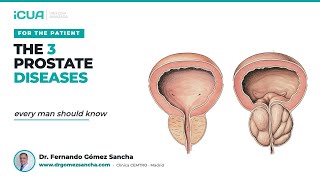
The 3 Prostate Diseases Every Man Should Know About
Dr. Fernando Gómez Sancha · ICUA
Dr. Fernando Gómez Sancha · YouTube
Language: English. Editorial classification in the patient catalog.
Playback connects to YouTube. Your search query is not sent to the player.
About this video
Did you know that over 50% of men over 50 have a prostate problem? In this video, Dr. Fernando Gómez Sancha — a urologist with 32+ years of experience and over 10,000 laser prostate surgeries across 52 countries — explains the three main prostate diseases in simple terms: benign prostatic hyperplasia (BPH), prostate cancer, and prostatitis.
🔹 What is BPH and why does it affect 80% of men by age 80?
🔹 Is prostate cancer always aggressive?
🔹 What is prostatitis and can it affect young men?
🔹 When should you see a urologist?
Documented details and sources
Only details explicitly stated in the sources. Missing information does not mean it did not occur.
No clinical case details have been extracted for this video.
Original title and description on YouTubeSource checked: 2026-10-04.
Video moments
Available transcript · English
Automatic YouTube captions; they may contain errors.
They may contain transcription or translation errors; check the explanation in the video.
- What diseases affect the prostate? Hello, I'm Dr. Fernando Gomez Sanchez, urologist and medical director of ICUA at the Centro Clinic in Madrid. I've spent over 20 years performing prostate surgery and today I want to explain something very basic that surprisingly few people are clear on.
- What diseases can affect the prostate? There are essentially three and it's important you know them because they're very different from one another. The first is benign prostatic hyperplasia.
- It's the most common one. This isn't cancer. It's a benign growth that occurs with age. From the age of 30, the prostate starts to grow and since the urethra passes right through the center of the prostate, as this tissue grows, this benign tumor that all men develop, it compresses it and makes it difficult for urine to pass.
- Typical symptoms include getting up several times at night to urinate, a weak stream, the feeling of not emptying completely, [music] urgency and sometimes not being able to urinate at all, which we call urinary retention, a painful condition that requires a quick trip to A&E to have a catheter fitted.
- It's the most common prostate disease. Practically all men will experience it to some degree if they live long enough. It's initially treated with medication and when medication isn't enough to improve the symptoms, with surgery. In my case, the technique I use most is HoLEP, Holmium Laser Enucleation, which I'll be talking about a lot on this channel.
- The second prostate disease is cancer, prostate cancer. It's the most common cancer in men, but there's a very important nuance here. Most of these tumors are low risk and grow very slowly.
- Many men live with prostate [music] cancer without knowing it and without it causing them any problems. And many men die with it, but not from it. That is, they die with a cancer they don't know they have because it's extremely common in elderly people.
- In fact, all men would have it if we lived to be 100. So, it's it's extremely common. Diagnosis is made with PSA, a blood test, and with a prostate MRI and biopsy when necessary. [music] And surgery isn't always required. Some cancers are actively monitored without immediate treatment. [music] When intervention's needed, at ICUA, we use da Vinci robotic surgery, which allows for prostate removal while maximally preserving urinary [music] continence and sexual function.
- The third prostate disease is prostatitis, [music] which is an inflammation of the prostate. It can be bacterial, caused by an infection, or what we call abacterial prostatitis [music] or chronic prostatitis, which is often a pelvic pain syndrome rather than an actual infection. It's more common in young men and although it's not dangerous, it can be very bothersome.
- It's treated with medication and in some cases, pelvic floor physiotherapy helps a lot, aimed at relaxing the pelvic floor muscles that are contracted. So, remember, [music] we have three conditions, benign prostatic hyperplasia, prostate cancer and prostatitis.
- They are three very different conditions that require completely different approaches. The most important thing is a good diagnosis, knowing exactly what you have and applying the right treatment. If you have urinary symptoms or they found an elevated PSA and you want an honest opinion, you'll find all the information at doctorgomezsanchez.com.
- And if you found this video useful, subscribe. I'm going to publish more videos like this, answering the questions that my patients ask me every day in the clinic.