
Surgery
RLHoLEPCase33: HoLEP after REZUM
Dr. Fernando Gómez Sancha · ICUA
Dr. Fernando Gómez Sancha · YouTube
Language: English. YouTube audio metadata.
Surgical content for professionals. Contains footage of an operation.
Playback connects to YouTube. Your search query is not sent to the player.
About this video
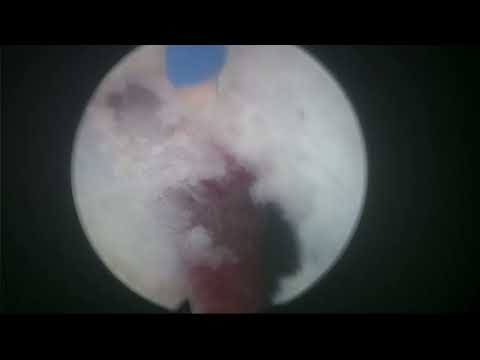
An en-bloc HoLEP after an earlier REZUM treatment. The published description reports persistent febrile urinary tract infections as the problem that led the surgeon to advise HoLEP. It does not report whether those infections resolved after this operation.
Documented details and sources
Only details explicitly stated in the sources. Missing information does not mean it did not occur.
- En bloc
This is an interesting case of En-bloc HoLEP in a patient who had undergone a REZUM treatment. He had continuous febrile urinary tract infections and I advised him to do a HoLEP.
- After REZŪM
RLHoLEPCase33: HoLEP after REZUM
Source checked: 2026-10-06.
Available transcript · English
Automatic YouTube captions, not clinically reviewed. Names, technical terms and numbers may contain errors. Check them against the video; complete audio coverage has not been verified.
They may contain transcription or translation errors; check the explanation in the video.
- hello this is fernando mesancha and i'm going to present a case of a patient who underwent rhythm treatment uh without success and he was complaining of recurrent infections and as you can see there was a cavity um apically near near the sphincter and probably that was the reason for his recurrent infections so he came to us asking for a solution he was happy to let go of the [Music] ejaculation he wanted to get rid of the febrile infections that he was having so
- i uh recommended him to have a a hole-up and again i think this video will show how nice the block approach is for redo cases and um just uh another uh proof of the versatility of this procedure of course you know failed uh treatments uh can happen with with um with any option for for for bph treatment and um yeah we we see them uh after uh almost everything including failed cases after hollap because
- there was complication or there was an incomplete removal of tissue well these things can happen and here uh what i'm trying to do is i'm trying to delimitate the line of the white line at the apex sometimes in this case the anatomy is somewhat distorted and well you have to to do your best to to understand but i have to say that when you do and block hollip which is always following more or less the same steps it becomes easier and easier uh to treat these these cases [Music] basically look for the reference of the interface between the normal and the
- capsule you can see it there quite clearly but of course often we see that there's a more fibrous quality of the tissue see that's that's the cavity this is the edge of the center so trying to mark the anterior part as well so here this would be the anterior part and now the white line is connected and this is a great reference and uh everything you have to do after that is to to go around there norma trying to evaluate if if the plane is correct you have to go a little bit deeper or if you're already going deeper and
- you have to correct your aiming so that you remain inside my favorite cases are the redo cases this is where i have more more fun because it's always a little bit of a challenge sometimes the effects of the previous treatment on the tissue are quite marked sometimes you know the plane is not ideal um sometimes you need to almost contact with the tissue in order to be able to cut through fibrous parts but the solution for these
- problems are usually quite quite easy this is the the quanta system laser uh with the pulse modulation uh at my current normal settings which are 2 joules and 50 hertz there you can see that sometimes plane is not very very clear so you have to judge and do your best and then at the end we'll have a look and see if there's any bump or any residual tissue but again the circumferential nature of this incision you know this
- dissection line is helping a lot because you can see that it makes sense to to go around like that and to follow the line you can anticipate a little bit how the anatomy is going to be irrigation is excellent visibility is excellent hemostasis provided by these lasers uh it's more i mean it makes the procedure more comfortable of course uh you can use a normal volume laser and but that will not have a such a nice first pass coagulation effect so you'll have to be more careful and probably go back
- to coagulate my feeling with the normal classic hormone is that often the the explosive nature of the laser will uh open up the vessels and there must be some kind of spasm of some of the vessels so initially this spasm will avoid bleeding but then after some minutes this vessels will relax and bleeding will start so you have to often review the the surface you have treated but here as you can see the chances of leaving uncoagulated tissues is a little bit less so this uh gives you the the
- advantage of uh a nice coagulation so that's again the posterior aspect we had a small discussion online you see that i keep my fiber at 12 o'clock [Music] all the time and i feel that that gives me a very good control i don't have to be moving my hand and it gives me precision in the sense that as you can see i'm firing often when when when the when the angle of dissection is is is changing for example here we are on top of the adenoma i start i start pointing down a little bit with with the fiber because the the
- the angle is is that way and when i am below the adenoma i have to be careful that i don't go through the retrotrigonal area so what i do is i keep the the targeting very close to the enoma that it cuts the attachments of the anoma with the capsule but the energy is not going towards the capsule so the risk of perforating is very low and my bet is when you have to move everything your chances of pointing or targeting your laser uh correctly are a little bit less maybe so this is why i keep the fiber at six o'clock or at 12
- o'clock i don't keep moving the fiber i just use this this position you see that that gives me excellent control and excellent simplicity as well i like simple stuff and i think maybe we can do ourselves we can we can make our operations very complicated when there's no need so here you see that's a small vessel near the bladder neck now we enter the bladder at 12 o'clock and again i will try to to do this circumferential dissection trying to judge if the plane is good enough
- or if it's too deep there's some fibrosity there there's some it's not a beautiful plane but there are some hints you always have to read the information you get in the screen you have to be very vigilant to see the anatomical details that will tell you if you're doing the right thing here you see i am posteriorly working near the adenoma you see my fiber is keeping close to the anoma so the capsule is receiving very little energy it's just going to the adenoma and in a way that cuts the attachments of the capsule with their norma so there is you know very little chance of of going
- deep in this in this region sometimes we have to dissect very very deep nodules and the capsule is very very thin and we can manage uh those with with this uh with this approach so here you can see how the fiber is still anteriorly i go around the adnoma but you see the energy so my point is the angle of incidents that you can get by rotating the fiber continuously you know the modification in the angle of incidence is not so relevant and to me it's more relevant to be able to target your laser very precisely either
- against the line of attack or a little bit inside that's a small nodule as you can see here or there you always have to no yes you don't want to fire there you want to fire a little bit more against the norma to see if we can cut these attachments without letting the energy go deeper so that's it so it's an ongoing discussion and of course we always learn from each other uh and it's interesting to to to to see what people think and have different opinions
- but i'm quite convinced that this is a nice way to go because it is simple you don't have to rotate the scope you have to keep the camera you just hold the instrument as you would hold a pistol if you're going to fire a pistol you fire keeping the the bullet outlet at 12 o'clock and this is more or less the idea so here you see it's always very careful you don't need to rush it but it will uh end very fast you see that when you work in this beautiful visibility conditions concentrating on where to target your laser
- what distance from the tissue you want to fire you find sometimes slightly more difficult angles or areas that make you sweat a little bit and but if you are calm you will get to the to the end of it i think uh because i don't exactly remember i think this was a problem with the fiber uh so i had to change it or something i don't remember what happened during the procedure so while i was waiting i was just checking things out there's just a little attachment on that side on the bladder neck
- that's the uo and that's the cavity very montanum and you can see the excellent excellent excellent preservation of the sphincter which is what we try uh to achieve because of course as you know incontinence after hollap even when it's temporary uh it's it's quite bothersome for the patient and it's absolutely in necessary to to to to to have incontinence after hollap there what i'm trying to say is that uh with what we know today you can perform hollap without causing stress incontinence in the great great majority of your patients so it's actually a rare
- event and when it happens it's absolutely mild and tolerable and the resolution is quite fast so all this uh and block a nucleation technique and the early epical liberation and the white line and all these concepts i think are uh improving as you can see i'm using a new fiber i don't know what happened this is quite unusual to have to change the fiber throughout the procedure but obviously something something happened so there again you see following the the contour following the line is a good idea you can see that i move
- usually from i don't i don't do very small movements but i try to do wide movements you see going all the way up so the philosophy is to try to release maybe a little but then take this little up and around so that you can develop a nice circumferential line and that's the almost the end you can see that we have a nice nice fossa good hemostasis some minimal attachment but now the case is finished um interesting hey i think rhythm has come quite hard as an option for for treatment and i think
- it is logical to see failed treatments because of poor patient selection and sometimes maybe because of inexperience of the surgeons who who are doing it i think as always when one does a treatment very often he learns and the the chances of problems are less and less so just uh different options what i feel sometimes is that the the promise of ejaculation is quite obvious for any man if you tell him you will ejaculate after the procedure he he will be happy this is a no-brainer you you want that but it's important to to tell the patient as well that sometimes things can go wrong and he
- might need alternative treatments uh he might have complications and it's important to have an honest discussion with patients so because in this particular case the patient was a little bit sad that he chose that path as things didn't work out well i i saw him recently he's quite happy his urinary symptoms improved a lot and he didn't have further infections and well he was tolerating the unejaculation without much concern as as he told me so again i hope you enjoyed this uh short case and i will try to keep posting interesting
- cases as i get some time free to sit down and edit these videos i'm getting very nice feedback from from some of you who watch these videos and i appreciate that and yeah as long as they are useful i will continue to post this is the more solution phase again i trying to simplify i use only one inflow which works well for me with this equipment but of course i am very very vigilant if more solution is not very efficient i'm very aware that i will be sucking out a lot of water and then i stop and refill before i continue
- with the perennial oscillation and more later modulation is usually very very fast and it allows i mean even stopping a little bit to fill the bladder it is a quite fast procedure and i prefer that to having two inflows which is a nuisance you know four bags two giving sets and here probably i was waiting a little bit sometimes the bladders are not so big and they feel very fast and they empty very fast that's the end of the of the procedure i hope you enjoyed all the best happy new year