
Professional education
Visit to Quanta System in Milano to learn more about the CyberHo 150 Watt Holmium Laser
Dr. Fernando Gómez Sancha · ICUA
Dr. Fernando Gómez Sancha · YouTube
Language: English. YouTube audio metadata.
Professional education. May contain surgical footage.
Playback connects to YouTube. Your search query is not sent to the player.
About this video
A visit to Quanta System's headquarters in Milan to learn about the CyberHo 150 W holmium laser used at the author's centre in Madrid. The description frames the recording around how a surgical laser works and its use for benign prostatic hyperplasia and stones. It is an equipment-focused visit rather than a documented individual surgical case.
Documented details and sources
Only details explicitly stated in the sources. Missing information does not mean it did not occur.
No clinical case details have been extracted for this video.
Original title and description on YouTubeSource checked: 2026-10-06.
Available transcript · English
Automatic YouTube captions, not clinically reviewed. Names, technical terms and numbers may contain errors.
Selected spellings of enucleation, morcellation and holmium terms have been edited. This is not a full audio or clinical review; the original captions remain the source.
They may contain transcription or translation errors; check the explanation in the video.
- [Music] hi I'm waiting for the plane to go to Milan I'm going to visit the quantum system headquarters and I'm going to learn about the their laser the laser we use in our in our operating room how it works and look at the inside of the laser and I hope we will learn a great deal [Music] [Music] [Applause] [Music] thank you hello I'm Fernando Gomez sancha from the icua clinical Center in Madrid Spain and I'm very excited to be in Milan at the quanta system headquarters to learn about their lasers and I hope you will enjoy this geeky review this is the Cyber holmium 150 watt laser and it's used for holep and you know that holep is the acronym for homium laser nucleation of the prostate which is the treatment we love and it's
- becoming the standard for the treatment of BPH I started using a green light laser for nucleation at the beginning but I soon realized that homium laser is probably the best tool for performing endoscopic nucleation of the prostate and that is because uh it helps you dissect the plane at the same time produces hemostasis there's very little mechanical effort you have to do to do a nucleation and that's why it's my favorite technique so as you know anatomic endoscopic nucleation of the prostate is becoming the standard and you can do it with different energy energy sources and holmium and especially the new generation homium is probably the best tool because it has a unique particularity that allows you
- to open the plane to dissect the plane following the right plane and it produces amazing hemostasis the the new homeium lasers have evolved to provide us with a better tool and I have to say if I have to face a difficult case monster prostate I feel much better equipped if I have this machine with me this laser has a very impressive specifications allowing to deliver 152 Watts 100 Hertz and it has a sophisticated pulse modulation it means that it can deliver two pulses very fast one after the other this is what we know as a virtual basket or double pulse or double bubble as as we say that in increases the ability of the laser to cut and coagulate so let's unfold this and I'm going to Unleash the Beast
- this is the the screen and the laser comes with two keys it's important to keep one safe just in case someone is funny enough to you know steal it but this is the starting switch there it is this is the noise from the ventilator system that is activating which will later on come down so the laser is checking uh the system everything is checks okay and we are ready to work so there's a system that assists you to use this laser and if you look at the first line you have different options for lithotripsy BPH or soft tissue applications but we have here Gregorio catinoli product manager of quanta system who is going to run us through the system yeah sure well actually it's very easy so you see you can peek from
- Little tripsy BPH and soft tissue so pretty easy let's say that well your top expert of inoculation so let's start with what I think you are more knowledgeable about so here you can see you have a dedicated one for a nucleation one for delicate areas if you want to up late or vaporize you have also a dedicated option and the coagulation settings so the pedal has two two switches and there's a third one on the top yeah and you can preset what's going to happen when you press one pedal and then the other pedal yeah you know ready the machine you have been using so definitely that's how it works so now I don't know it's not really your favorite one but let's focus for a while only to trypsy you see we have two
- options for dusting with high frequency or with the important technology you can pop corner and finally you can also fragment that you can give selection and just to conclude we have also the soft tissues part so for cutting tool or for ablation you can select a dedicated one and finally also for coagulation of small leaders so this is this is a an assistance for people who are not very knowledgeable about laser physics but if you want to to set the laser according to your needs I mean what is how how do you use this if you have more experience yeah definitely so you can start with setting the device in the settings you want to save and then what you can do you can go menu presets and then you can add the name of the of
- your name your colleague which has less experience than you so in a hospital five surgeons with different preferences you can have as many presets as you want exactly here we are regulating wattage so joules and Hertz exactly or the pedal for the last one exactly yes this is uh the setting you want the mode of emission no the pulse modulation emission mode exactly the the other element is the pulse duration adjustment so it goes from short pulse to Long pulse guys if just really a quick reference when if you are not sure about short or long pouch remember just look at the base of the icon here so you see here Fernando here we have a very short base of the icon so it means short pulse on the other end at
- the bottom we have a long pile we have a long icon the base of the icon is very long which means long pulse and if you choose one of these modes for example virtual basket okay you cannot choose a white poles or short pause that's a good observation because indeed when the device is set in advance Parts modulation basically what happens is that the device is going to regulate automatically and adjust the duration of pulses the splitting of energy automatically why should I use a shorter or longer poles in lithotripsy this is very important and you may not know that already let's look at this video from quanta Lab how the stone stability is affected by pulse duration a short pulse results in less stability as you can see and it's
- generally used for fragmentation purposes for BPH you can also choose between a short pulse and a long pose I like the short post because the blast is very strong and it opens the plane very nicely but if you use a longer pulse it's going to be more gentle in the dissection and more hemostatic but you will lose some of the mechanical aggressiveness which is nice and holep to keep and develop the proper plane so you can find your balance in between those Effects by tuning the pulse duration of course if you use the advanced pulse modulation I think you will not need to worry about this because post modulation is in my opinion the champion setting for holep now it's open now it closes so Greg what's going on here when I put my hand
- here the connector opens and when I take it out it closes automatically what's what's this yeah it's actually to protect the connector part the laser protect it from from what from dust or any touching by other operators so that's your dust in there is a bad idea yeah yeah definitely you want to protect and limit any access to this one when it is not operated and used but now I have a fiber with me so what happens is that once you connect the fiber pin so you see I'm approaching it opens automatically now I screw the fiber and together we can see that the fiber will be recognized automatically so you see now the system you know Fernando if you can read the yeah 550 this is my favorite fiber for for
- holep and if I want to put my settings I would need to choose the jewels in this case it's two joules what I use otherwise I would press up and down to to to to select less power or more and then the Hertz I would go up 250 which is my preferred setting sorry okay and so it went down because I was accidentally going up with the Hertz no but exactly so I have to go back and check two and that's uh and then if I press the magic wand yes and choose virtual basket which is the setting I I love for homium um then I have my settings for the left pedal correct and then uh for coagulation I would choose something in the region of uh uh for example 30 or 40 Hertz and one joule this would be correct and then I would choose the
- bubble blast setting which produces a very soft a nice spread of the energy for coagulation and uh we're all set okay Gregorio this is the pedal and it has several components this would be the cable and I would like to tell everybody that the pedal is not hold like this if you do this it will break over time you have to instruct your nurses to try to get the pedal from any other part of the device rather than the cable and we have two foot switches it's a standard to use this for cutting and dissection and this for coagulation can you can you can you switch if you have a preference uh can you do any setting in either pedal yeah they are independent so you are completely free to assign a certain value or settings one another so
- if you are if you are a little bit strange you can choose to do it the other way around and then there's another pedal many people don't know that the black one is a is a petal and if you press it it will switch the state of the laser from standby to ready except the first time yeah that's correct so for the very first time that you want to move from standby to ready you need to do actually on the screen then after that you are completely free and you are independent to switch by by means of that one so the surgeon doesn't have to say set it turn it off or put it in standby you can do it with your own foot so and one question what is this uh what is this window here oh to remove sorry I think I broke it correct no no
- don't worry don't worry it's just magnetic connection so now you can do this as you see you can reattach pretty easy that's a really lucky use okay so what is what do we have in here here we have what we call the the blush Shield so it's a it's a protective element you can try to unscrew that pretty pretty easy so you can rotate last Shield what does what does he do so it's a shield against blasts indeed so basically here on top you have a lot of expensive and pretty delicate elements and you want to protect any back scattering any problem of transmission and you want to avoid any damage to these expensive Parts but what what explain to us what is back scattering so in this case the problem water can
- happen is that either the fiber that you are connecting is already damaged so the transmission from the laser to the fiber and then to the patient is basically altered so what happens is that instead of moving from the inner or the laser outside there is a part of the radiation which stops there part of the light reflects tries to go inside not the correct way not the correct movement and in this case this element is protecting the inside of the laser so it's absorbing this this crystal inside the the blast Shield allows the light to pass in this direction but not on the other on the other direction is that correct no actually potentially you can also plug it also in the opposite but what is
- important is that if this gets damaged basically you are you have something which is not transparent anymore or which is not allowing proper flow through that and this will result in unproper functioning you will hear actually yes it happened to me I was operating and then I started hearing a noise and then we stopped and it was a problem with the blast Shield so to me this is uh like protection if you're firing again and you wear glasses to avoid the the the the explosion to hit your face okay so uh let me show you I have given me one of these blast Shields that was damaged I don't know if you can see the the look of damaged blast Shield yeah indeed so you see here you have some spot some marks in this case once
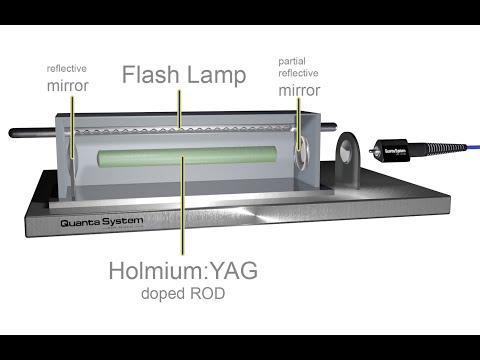
- you arrive to this condition the transmission won't be any more efficient so actually you will have a growing damage on this part so the best way to do if you hear this noise or if immediately if you see that effect on the tissue or the stones is not anymore what you are expecting with respect to what you have set on the on the system the best way is to stop putting standby and check it if it is like that in this case simply you remove it and even your nurse pretty easy also for this troubleshooting they can replace it with a new one you know Greg nurses are much more intelligent than doctors in general well in theory we know how a laser is produced we have seen this picture where you can see a flash lamp and a solid
- Crystal that will produce the laser this is a laser chamber this is where the magic happens but in order to explain it I'm going to call Fabio pagliari hello Fabio hello maybe you can tell us how this works so this is a pumping chamber a diffusive pumping chamber on the bottom connected to the electrical power supply we have a flash lamp so this is a famous flash lamp Okay this is The Flash lamp so how does it work it is a closed uh close display in quartz and there are two electrodes that make a spark a spark so there will be a spark going inside and what is inside the the E chamber the gas is all right so this will flash many times it will flash many times each time in the current it's flown it will make a
- big Flash and it will provide the energy to the laser Crystal that is uh this is the laser Rod or the laser this is a solid state laser solid state laser so the crystal is in the shape of a rod so this is a homonym Crystal this is green greena is the part that absorbs the light from the flashlight so this would be more or less positioned like that in a diffusive chamber so that even the light that goes not directly in the road the wheel will go back and circle it so this uh this mechanism produces a lot of heat that produce a lot of it that produce around one kilowatt of heat and the heat will need a lot of water to be removed okay so you will irrigate inside this chamber in this laser we will pump water from the bottom in
- pressure like milliliters per minute and many videos perminos it's like a a tap completely completely open that is Panther inside and sucked out and Rod and flesh lamp will be completely immersed in this in this water to to get refrigerated okay this is amazing I didn't know this was green this is a shock for me how many pumping Chambers has this laser inside this laser area is the 150 watts as four pumping chamber each one providing 35 Watts 35 Watts okay so let's see how it works the emission of homium lasers is produced inside boxes called cavities that contain a flash lamp that transmits the energy to the laser rod a hobium yak doped road that excited by the lamp produces photons at a wavelength of 2.1 microns
- two mirrors one fully reflective on one semi-reflective allowing the recruitment of the number of photons necessary for the formation of the laser beam emitted out of the cavity and inject it into the surgical optical fiber in the video the lamp is turned on starting the photonic stimulation the laser formation process needs a cooling system to avoid damage on a homemium rod and cavity components the photons bounce between the mirrors until the number recruited is sufficient to induce laser emission that occurs Through the semi-transparent Mirror the laser beam is then injected into the optical fiber through a focusing lens the power emission depends on the characteristic of pulse energy and
- replation rate controlled by the interaction between the flash lamp and the doped Rod Crystal in multi-cavity lasers like the high power homium system 60 100 or 150 watts the features of the single poles in terms of duration and energy are about the same as single cavity lasers with 35 Watts as maximum power instead the maximum frequency emission at the maximum power output are multiples of the cavities included in the system in the video four cavities are entering in a mission in an alternating sequence each laser beam is redirected to the focusing lens by a rotating mirror if you select 100 Hertz for the laser emission this mirror will change its position 100 times per second with micrometric Precision to ensure proper
- functioning of the laser system special sensors installed inside the optical bench constantly measure and monitor that the laser performances are stable and that the internal components are properly cooled by the chiller system to ensure the best performances and reliability for the doctor engaged in laser surgery I'm using a special application in my phone to measure the amount of noise that the laser is producing so if I shout ah it goes up and if I remain silent it's going to measure how much noise the laser produces you can see it's extremely silent we will have to try in the operating room as well we're going to measure the noise in real life it's quite silent we have to record later when it's
- operating we'll filter enough clockwise so it has been an exciting day today at quanta system headquarters I have seen the production line and I have had a chance to discuss the technical aspects of the machine with the guys who really created it and work on it every day and I have to say I'm very impressed and I think it's uh it's a very good device uh for lithotripsy for breaking stones and for BPH and to me the main features that make it attractive are that you can use our reusable fiber that is quite silent in the operating room and I think that's really important for for us for the surgeons and of course it has a lot of benefits that will impact the quality of life of your patients so I hope you enjoyed the review uh
- subscribe to my channel if you're interested in content like this and see you soon thank you for your attention