
Surgery
Redo En bloc HoLEP with early apical release after different previous endoscopic treatments
Dr. Fernando Gómez Sancha · ICUA
Dr. Fernando Gómez Sancha · YouTube
Language: English. YouTube audio metadata.
Surgical content for professionals. Contains footage of an operation.
Playback connects to YouTube. Your search query is not sent to the player.
About this video
A reoperation demonstrating en-bloc HoLEP with early apical release after previous treatment for benign prostatic hyperplasia. The description discusses TURP, open prostatectomy and laser treatment as possible prior procedures in retreatment patients. It does not identify which of those procedures the patient in this recording had undergone.
Documented details and sources
Only details explicitly stated in the sources. Missing information does not mean it did not occur.
- En bloc
Redo En bloc HoLEP with early apical release after different previous endoscopic treatments
- Early apical release
Redo En bloc HoLEP with early apical release after different previous endoscopic treatments
- Redo surgery
Redo En bloc HoLEP with early apical release after different previous endoscopic treatments
Source checked: 2026-10-06.
Available transcript · English
Subtitles exported from the original-language YouTube Studio editor. Not clinically reviewed; source identity and timestamps verified, full audio coverage not verified.
They may contain transcription or translation errors; check the explanation in the video.
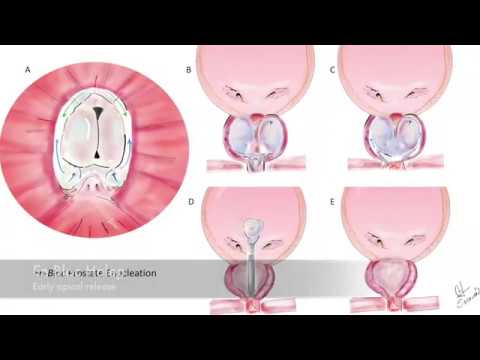
- redo and block halep for prostate adenomatous remnants at the ICU a in Madrid we had published in n block a green light a nucleation technique and from there we evolved to Anam block Halep with early apical release in men with prostatic hyperplasia we present this video to describe the use of this technique where an incision is carried out at the apex to separate the sphincter from the prostatic epics and then a circumferential incision is carried out to remove the adenoma and block into the bladder in cases that were previously treated this case is a patient who was submitted to an open prostatectomy 10 years ago and it was obvious that some regrowth of adenomatous nodules has taken place so the operation always starts by
- marking the limit of the sphincter with the apex in this case we are using the moses fiber with the moses settings that's the crystal released on top of the vermont alum that is cut to be able to start separating the apex from the sphincter at the beginning of the procedure so you can see the sphincter is perfectly preserved from that moment on the ad namah is going to be dissected circumferentially we have learned over time that despite the appearance that the fossa is quite well let's say resected or free from adenomatous tissue in these redu patients one has to look for the proper plane and follow it because many times we see that there is anomalous remnants even in the areas where apparently the tissue is properly removed this is the pre and post-operative aspect
- in this case the worst remanent apical prostate and Noma after TRP this patient was submitting himself to self catheterization because he had two times T or B and they were assuring him that he had a weak bladder we performed urodynamics on this patient and we saw that he had very good bladder contractions but he was heavily obstructed so we found this apical remnant at the apex and we decided to carry on a Anna block removal of this tissue so again right at the interface between sphincter and a dramatist remnant we performed a circumferential incision this incision allows us to separate the sphincter from the apex right at the edge allowing for a total D obstruction of the bladder outlet this was a relatively fast and easy operation and as we mentioned
- before it's important to try to get all the way down to the capsule in this case after t 2 TR piece it looked as if there was not much tissue left but one has to try to go all the way to the capsule and remove all the remaining abnormal tissue that's the crystal race rallies over the very moment annum and it is possible to see that there's still some tissue left and it would be very sad to do a retreatment on a patient and leave a residual animal tissue that could cause problems again the patient voided the next morning after four years of self catheterization he was extremely happy you can see the excellent preservation of the sphincter this third case is a redo and block halep after tulip this patient was submitted or I
- would say after the two web because through lab is supposedly able to remove all the anomalous tissue but in this case despite there was a good cavitation in some of the aspects of the of the prostatic fossa there was residual tissue and again this is the circumferential incision carried out cutting a crystal with rallies and dissecting the tissue all around the prostate again despite the look of a nicety obstruction on the left side we followed the plain anatomical plain to perform a total in block nucleation of the prostate and it is very striking to see how much tissue was left in this case and very satisfying to be able to remove everything this and block approach provides very good irrigation very good visibility and this is the
- tissue that was left behind that has been removed completely with this end block technique so as one can see after watching these videos the apical preservation is amazing the treatment is radical and definitive I think it's very unlikely that these patients will ever need another operation and then we present this last case where after vaporization of the prostate the patient had still bothersome symptoms and again you see that over time when a notice tissue is left behind there is further growth again the same strategy again using the moses technology that provides excellent cutting properties an excellent coagulation especially useful when there is fibrous tissue that's again cutting crystal rallies or whatever is left of it on top of
- the very montana and a circumferential dissection not settling for what looks as a nice cavity but trying to follow the anatomical plane between adenoma and cancer in some areas that might be a good original work and the tissue might have been taken down to the capsule but in some other areas there is still residual tissue this is the last case again excellent preservation of the sphincter and the sphincters melosa and as a conclusion and block Halep is effective for redo procedures there's always more tissue to remove then it is apparent by any book of the fossa and a radical removal of anomalous tissue will reduce the chance of retreatment in the future