
Surgery
HoLEP After Aquablation Failure: 90 cc Regrowth at 2.5 Years
Dr. Fernando Gómez Sancha · ICUA
Dr. Fernando Gómez Sancha · YouTube
Language: English. YouTube audio metadata.
Surgical content for professionals. Contains footage of an operation.
Playback connects to YouTube. Your search query is not sent to the player.
About this video
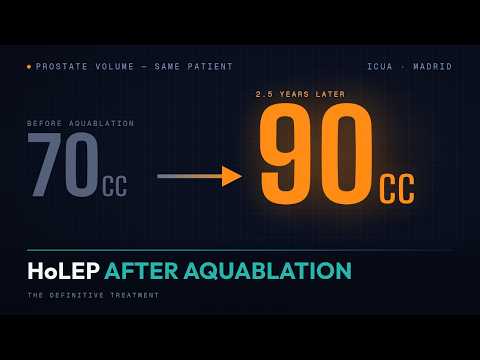
A HoLEP reoperation two and a half years after Aquablation in a 75-year-old patient. The description reports a prostate measured at 70 cc before the previous treatment and 90 cc at reassessment, with residual apical tissue, a distorted cavity and a hypocontractile bladder. The case focuses on finding the surgical plane after an earlier ablative procedure.
Findings before retreatment
The description reports residual apical tissue at cystoscopy and a post-void residual of 200 mL on urodynamic assessment. The 70 cc and 90 cc figures refer to measurements before the earlier treatment and at reassessment, respectively.
Scope of the case
The operative discussion concerns distorted anatomy and the surgical capsule as a reference for re-enucleation. This is one documented retreatment case; the description does not provide a comparative failure rate for Aquablation or long-term outcomes after this HoLEP.
Documented details and sources
Only details explicitly stated in the sources. Missing information does not mean it did not occur.
- Redo surgery
When retreatment becomes necessary, the question is not whether HoLEP can be done after Aquablation — it is how much tissue was left behind.
- After Aquablation
HoLEP After Aquablation Failure: 90 cc Regrowth at 2.5 Years
- 90 cc
HoLEP After Aquablation Failure: 90 cc Regrowth at 2.5 Years
- Hypocontractile bladder
Urodynamics showed a hypocontractile bladder with a post-void residual of 200 mL
Source checked: 2026-10-06.
Available transcript · English
Texto y tiempos de la pista publicada por el canal. Puede contener errores; no se utiliza para inferir atributos clínicos.
They may contain transcription or translation errors; check the explanation in the video.
- Hi, this is Fernando Gomez Sancha and this is an interesting case of a man who was submitted to a previous aqua ablation. This man had an aqua ablation procedure two years and a half prior to coming to see me. He had been studied because he was not peeing very well, he had a urethrogram that didn't show much and a cystoscopy that showed residual apical tissue and a little bit unfracturous fossa, probably showing that the debulking was not enough to get the patient to improve. He had a urodynamic study where a weak bladder was found and residual urine was about 200 milliliters. The maximum flow rate was 6 milliliters per second with a very slow flow. The patient wanted to be
- treated. This is a synechia. We see this quite often when the adenoma is not completely removed but it was getting longer and longer so I decided to leave that and go back to the sphincter pillar lateral pillars to be able to mark the white line as we usually do. This video was missing in my collection. I don't recall having published a post post-aqua ablation treatment before and we have published here in this channel I think re-treatments after most minimally invasive available treatment. I recall having operated patients after ITIND after Rezum after Urolift
- and this was missing from there from the library so I was quite happy when I had this patient thinking that I might be offering this video with yet another case of redo. I have to say that I have also re-operated patients after HOLEP where probably the apex was not aggressively you know removed enough and I also have a couple of videos I think of patients operated after open prostatectomy so there is a possibility to have a retreatment after most surgical options and of course I think it's very important to have in mind that the patient is submitting himself to a second operation and I think it's a good idea to try to do a definitive
- treatment if it's possible, try to release the patient from this suffering and try to solve the problem once and for all. We can just try, this is what we do as surgeons, try and here we are I think that aqua ablation is being marketed now as a very good solution for men because it's quite safe and many patients will keep their ejaculatory capabilities but there is a chance to leave residual tissue. I did some cases many years ago and I still follow them up. These patients still are being reasonably well, not as well as when they had the operation. But the residual volume of their prostates is not as small as what we see
- when we do HLEP. When we do HLEP the prostate gets down to 15 maximum 20 grams of tissue and then it doesn't grow and I think this aqua ablation patients that I did many many years ago are now having prostate volumes about 60-70 grams. So there might be, you know, a concern with durability, although they seem to keep up quite well for the first initial years. So to me, it's very important to, if you're going to do BPH and if you're going to offer alternative treatment to patients, you should really read the papers with a critical mentality because there's a lot of industry influence on how these papers are designed,
- how they are carried out, how they are reported. And sometimes the initial look at the paper might be very positive, but when you start digging a little bit deeper on how the, you know, conclusions are supported by the data, they will be very positive. So I think that's a very important point. Sometimes there's a discrepancy and we have to be critical about that and not buy into what industry says, you know, just like that. Now we have to be a little bit critical because we have seen it before. In BPH, in incontinence surgery, there's always this promise of a new treatment that is going to change everything. And then there is this hype, people, you know, jump. To use these treatments. And then there is this, how do you say, lack of validation.
- When you start using these treatments yourself, you realize that the promise that the industry made about these products is not keeping up to its promise, you know, to the value for the patient. And then you start probably indicating less and less or indicating better and better. You know, for the patient where the minimally invasive option or could be more adequate. In this case, this man, 75 years of age, he had a bulky prostate when he had the aquablation. He had like 70 grams estimated volume. Interestingly, the preoperative volume was estimated now, two years later, at 90 grams. So probably there was not much tissue removed. Also, it is possible. How do you say, that the performance of the operation was not totally correct, which is a possibility.
- Sometimes, like when someone is starting with HOLEP, maybe his execution is not perfect. But I think we have to be careful because there's a lot of industrial influence on published papers. And we have to be careful and, as I say, read them carefully. Because. And probably have a look at the independently carried out studies rather than the industry-funded studies. Because when industry funds, probably the influence of the company in the papers is quite substantial. So here we are. As you can see, this was an operation where I didn't have any visitor. Normally, in my sessions, there's always someone watching operations. So. I tend to, you know, maybe go a little bit slower and explain a little bit more and stop during the operation.
- Some of the many, many or maybe most of the videos that I have that I have published here happen in front of someone, you know. And in this case, I was alone. It was a morning list, which is not very common for me. And so I could rush a little bit through the through the operation without having to explain. So. Having to explain anything. So you might notice some additional dynamism. You know what I mean? I I'm not stopping so much. I'm not being so, let's say, I'm going a little bit faster than I would usually go for for a teaching case. No, if we. But you see, the wonderful thing of the block technique is that when you get used to the movements, when you get used to the to the steps of the approach. The last layer of preparation, then it it's it's very intuitive and it's very automatic.
- I don't know what was happening here. Maybe changing the pedal or something, a little stop there and then a continuation. And here, this is now the connection at 12 o'clock. You see, I'm connecting one side with the other side, and I'm noticing that there's. Some anterior tissue that was left apically sometimes if I see that the plane I took on the flight is on the left side of the plane. Let's hope I'm not getting lost. So as we go through the process, we can see I'm courageously moving that the plane is moving. And all of that is pretty much what I'm expecting with that. So I can imagine I'm, I'm, I'm not seeing that this is a flimsy operation. Sometimes if I see that the plane I took on the other side was not deep enough, I will try to, you know, find the best possible plane. I don't want to leave residual hyperplastic tissue. And sometimes the planes are very, very clear and sometimes not so clear. So you might have to revisit like I'm doing here. We took a, you know, not so deep route before, but now it's being corrected in order to do an aggressive removal of the whole adenoma.
- All right. So that's the idea. So as a general rule, when you do a redo case, when you reoperate a patient, you should be exploring the capsule completely around the adenoma. You know, don't just remove one. No. One lobe or one. Sometimes you enter and there's a nice looking cavity. Maybe you think, wow, the right side was resected very well and there's only a bump on the left. So I will remove the bump of the left. Now, typically, it's much better to go into the plane near the veru and then look around and you will find that most times there will be a significant amount of tissue left. So here we are now. This is the entry into the bladder neck. You can see the vertical fibres, very easy to recognise landmark, and that's now the work on the bladder neck to try to open up the bladder neck.
- Sometimes in the redo cases, we find that there is some fibrosis in the areas where, you know, energy has been used and after a coagulation, there has been some coagulation performed at the bladder neck. Some region, some resection, so you might expect to find some fibrosis there. You see the line, the circumferential line of dissection is a good way of getting oriented and the tissue must have been quite hard because, as you can see, I'm doing some contact in the dissection. So sometimes if I feel that the near contact firing is not dissecting fast enough, sometimes I might get quite close to the tissue. Here at the bladder neck level, usually I do contact because I really want to perforate there.
- I want to perforate into the bladder. I know that if I perforate it's going to be safe because the bladder is on the other side. So often you see the bladder neck fibres are quite hard and here I tend to do contact. But for the rest, I usually use... ...a distance that provides a very soft, very careful dissection effect because we want to recognise if we go deeper or if we go into the capsule a little bit, we don't want to, of course, cause a perforation that has no solution. But I'd rather, you know, want to see that I'm getting deeper so I can correct... ...I'm getting deeper into the peripheral zone so I can correct my aiming. ...I'm getting deeper into the peripheral zone so I can correct my aiming. ...I'm getting deeper into the peripheral zone so I can correct my aiming. ...in order to try to prevent going even deeper and then maybe establish a perforation.
- Whenever I see yellow tissue, I explore below it because I want to remove the whole adenomatous tissue. And that brings me sometimes to relatively deep planes with very thin looking capsules. And we have to be careful. Here the aiming is against the adenoma rather than on the capsule... ...here the aiming is against the adenoma rather than on the capsule... ...here the aiming is against the adenoma rather than on the capsule... ...because we want to be careful. We want to prevent the energy reaching the capsule and deepening into the capsule. So this is the 6 o'clock region. Moving from the sides downwards to try to finalize the enucleation. And, well, I think if aquablation is being heavily promoted, I think... ...and you see, for example...
- ...the SIU guidelines recently promote aquablation quite clearly. You know, it's the only technique that shows a photograph. It's the only technique that is mentioned by its commercial name in the guidelines. And despite a lot of evidence recommending HOLEP for all sizes of prostates... ...this guideline is saying that... ...HOLEP should be used in prostates bigger than 80. And we know that aquablation is specially recommended for prostates below 80 grams... ...although they now try to expand the indication to bigger glands. So there's a lot of promotion of aquablation... ...and I think we will get to see more and more cases like this...
- ...where the insufficient removal... ...of tissue requires a second operation after time. But it seems to be holding well for the first years. But let's see what happens because maybe the volume reduction... ...that we get with aquablation is not as complete... ...as the volume reduction that you get after enucleation. That being said, you can see that it's been now 15 minutes of operation... ...and now we're nearly finishing. So it was a fast case and it behaved very well. And now, of course, I want to check the position of the UOs... ...and make sure to protect the UOs when we detach the adenoma from the bladder neck.
- Typically I like to come from the sides until I reach more or less the midline... ...here. I wouldn't want to continue dissecting there towards the other side... ...because there's a chance to hit the UO from the contralateral side. So I'd rather go from lateral towards medial like I'm doing now... ...to finalize the detachment of the prostate. And there we are. Just another case of enucleation. And if I see the histology of the patient... ...and we can estimate the weight of tissue removed... ...I will publish it on the comments later on.
- I don't have it at this stage that I know of. Maybe we can check... ...because I had opened the clinical record of the patient right in front of this video. No. No. We still don't have the histology yet. So I will place it on the comments. And that's the... You know, there was a little bit of adenoma there. You see, but it's relatively close to the UO. So I chose to vaporize, you know, that little bit of tissue there. It serves as a hemostatic. And, you know, trying to remove this little bit of yellow tissue. You know, the fiber measures half a millimeter. So that probably was a two millimeter or three millimeter bump of tissue there. And now it's the time to move on to morcellate.
- So there we are. This is the review of the fossa, the trimming phase that we do. There we are. So you can see the trabeculated bladder. So this patient had... You know, problem with their bladder function due to long-standing probably obstruction. You know, and probably the selection of the operation was not the best for this case. So I think as urologists we have to remain critical. And we have to acknowledge that there was a recent review where they say that
- in minimally invasive treatments for BPH, in the literature up to, I think, 60% of the papers have heavy influence by industry. So we have to be critical and not just read the abstract, but read the paper and try to understand what is happening. Because we have seen it. You know, we forget history. But in history of urology we have seen many hypes of BPH treatments, you know, treatments for incontinence. And such. And after the hype comes the deception. You know, because people believed that the new treatment was going to change things. To painfully understand that the change didn't happen. You know, and even heavily promoted treatments in the past are now totally abandoned.
- You know, like tuna, microwave. There were so many surgical options that didn't live up to the original promise. So we have to learn from history and be cautious when we adopt new technology. And then, of course, be very critical and very honest about the results we're getting. You know, and then decide. One of the very nice things of offering HOLEP is that you have an excellent operation in your hands. You have a high degree of patient satisfaction after HOLEP. And I always say that these are the happiest patients that we see. And, you know, we get all the good things. We get very good flow, very good bladder emptying. We get probably the biggest, let's say, improvement that a patient can see
- after BPH surgery. We see all the good things. And, you know, with this en bloc approach and with the early apical release and the preservation of the mucosa and with careful manipulation of the endoscope and bringing the adenoma to the middle, trying to reduce the traction on the sphincter, I think the incontinence rates are very, very low. Of course, we see the occasional case where a patient suffers from incontinence, but it's usually not huge incontinence and temporary in the majority of cases. And even patients who had incontinence at the beginning are very happy afterwards. So I think it's really nice to be able to do HOLEP, to offer it to your patients.
- I publish these videos with the hope that people will get convinced and will start learning because I think it's one of the most gratifying operations there is. You feel that you're doing something for the patient which is really good. And I have to say that, you know, if you travel to America, you know that you can find patient groups, patient support groups for all kinds of conditions like urinary incontinence after radical prostatectomy. You can find for, you know, erectile dysfunction after radical prostatectomy. But there is no single patient support group for patients damaged by retrograde ejaculation. And we see a lot of activism by industry trying to tell us how patients want to ejaculate. But the patients themselves are not telling us how unhappy they are with their retrograde ejaculation.
- So we have to keep in mind that, when we have a patient in front of us, we have to be honest with them. We have to tell them about the options there are. But we have to tell them about the limitations of the different approaches, the risks. And tell them what risks do they have in our hands compared to other treatments. So one more video for you to watch. And I hope you enjoyed and I'm happy to read your comments. And this was the end of the operation. And the catheter was withdrawn the following day. The patient peed very well. I'll keep you posted. Thank you very much for your attention.
Available transcript · Spanish
Subtítulos en español publicados por el canal. Pueden ser una traducción asistida por IA; no se utilizan para inferir atributos clínicos.
They may contain transcription or translation errors; check the explanation in the video.
- Hola, soy Fernando Gómez Sancha y este es un caso interesante de un hombre que fue Este hombre se sometió a un procedimiento de ablación de agua dos años y medio Él había sido estudiado porque no estaba orinando muy bien, tenía un uretrograma que no mostró mucho y una cistoscopia que mostró tejido apical residual y un poco fossa un poco sin fracturas, probablemente mostrando que el desbloqueo no fue suficiente para obtener el paciente Tuvo un estudio urodinámico donde se encontró una vejiga débil y la orina residual era de aproximadamente Doscientos mililitros. El caudal máximo fue de 6 mililitros por segundo con un caudal muy lento.
- Esto es una sinequia, lo vemos muy a menudo cuando el adenoma no se ha eliminado por completo. Pero se estaba haciendo más y más largo así que decidí dejar eso y volver al pilar del esfínter pilares laterales para poder marcar la línea blanca como lo hacemos normalmente. Este video faltaba en mi colección. No recuerdo haber publicado un post tratamiento posterior a la ablación por agua antes y hemos publicado aquí en este canal creo que re-tratamientos después de tratamiento más mínimamente invasivo disponible. Recuerdo haber operado a pacientes después de ITIND después de Rezum después de Urolift
- Y esto faltaba de la biblioteca, así que estaba muy feliz cuando tuve a este paciente. pensando que podría estar ofreciendo este video con otro caso de rehacer. Tengo que decir que también he re-operado pacientes después de HOLEP donde probablemente el ápice no era agresivamente Ya sabes lo suficiente eliminado y también tengo un par de vídeos creo que de los pacientes operado después de una prostatectomía abierta, por lo que existe la posibilidad de retratamiento después de la mayoría de las opciones quirúrgicas y por supuesto creo que es muy Es importante tener en cuenta que el paciente se somete a una segunda operación y creo que es una buena idea para tratar de hacer un definitivo
- tratamiento, si es posible, trate de liberar al paciente de este En el caso de los países en vías de desarrollo, el problema de la exclusión social se plantea en el contexto de la crisis económica mundial. Tratar, esto es lo que hacemos como cirujanos, tratar y aquí estamos Creo que Ablación por agua se está comercializando ahora como una muy buena solución para los hombres porque es bastante seguridad y muchos pacientes mantendrán sus capacidades eyaculatorias, pero hay una Hice algunos casos hace muchos años y todavía Estos pacientes aún se encuentran razonablemente bien, no tan bien como cuando tuvieron la operación. Pero el volumen residual de sus próstatas no es tan pequeño como lo que vemos
- Cuando hacemos HLEP la próstata se reduce a 15 máximo 20 gramos de tejido y luego no crece y creo que esta ablación de agua pacientes que traté hace muchos años ahora tienen volúmenes de próstata de unos 60-70 gramos. Así que podría haber, ya sabes, una preocupación con la durabilidad, aunque parecen mantenerse bastante bien durante los primeros años iniciales. Así que para mí, es muy importante, si usted va a hacer BPH y si usted va a ofrecer tratamiento alternativo a los pacientes, Deberías leer los periódicos con una mentalidad crítica porque hay mucha influencia de la industria en cómo se diseñan estos periódicos,
- cómo se llevan a cabo, cómo se informan. Y a veces la mirada inicial en el papel puede ser muy positiva, Pero cuando empiezas a profundizar un poco más en cómo las conclusiones son apoyadas por los datos, serán muy positivos. Así que creo que es un punto muy importante. A veces hay una discrepancia y tenemos que ser críticos sobre eso y no comprar en lo que dice la industria, ya sabes, así como así. Ahora tenemos que ser un poco críticos porque lo hemos visto antes. En la HPB, en la cirugía de incontinencia, siempre hay esta promesa de un nuevo tratamiento que va a cambiar todo. Y luego está este bombo, la gente, ya sabes, salta. Para usar estos tratamientos. Y luego está esta, cómo se dice, falta de validación.
- Cuando empiezas a usar estos tratamientos tú mismo, te das cuenta de que la promesa que la industria hizo acerca de estos productos no está cumpliendo con su promesa, ya sabes, al valor para el paciente. Y entonces probablemente empiezas a indicar menos y menos o indicar mejor y mejor. Ya sabes, para el paciente donde la opción mínimamente invasiva o podría ser más adecuada. En este caso, este hombre, de 75 años de edad, tenía una próstata voluminosa cuando tuvo la aquablación. Tenía un volumen estimado de 70 gramos. Curiosamente, el volumen preoperatorio se estimó ahora, dos años después, en 90 gramos. Así que probablemente no se le quitó mucho tejido. Además, es posible. ¿Cómo dices, que el desempeño de la operación no fue totalmente correcta, que es una posibilidad.
- A veces, como cuando alguien comienza con HOLEP, tal vez su ejecución no es perfecta. Pero creo que tenemos que tener cuidado porque hay mucha influencia industrial en los artículos publicados. Y tenemos que tener cuidado y, como digo, leerlos cuidadosamente. ¿Por qué no? Y probablemente tienen un vistazo a los estudios realizados de forma independiente en lugar de los estudios financiados por la industria. Porque cuando los fondos de la industria, probablemente la influencia de la empresa en los periódicos es bastante sustancial. Así que aquí estamos. Como puede ver, esta fue una operación en la que no tuve ninguna visita. Normalmente, en mis sesiones, siempre hay alguien vigilando las operaciones. Así es. Yo tiendo a, ya sabes, tal vez ir un poco más lento y explicar un poco más y parar durante la operación.
- Algunos de los muchos, muchos o tal vez la mayoría de los videos que tengo que he publicado aquí suceden delante de alguien, ya sabes. Y en este caso, estaba solo. Era una lista de la mañana, que no es muy común para mí. Y así podría apresurar un poco a través de la a través de la operación sin tener que explicar. Así es. Tener que explicar cualquier cosa. Así que usted puede notar un poco de dinamismo adicional. ¿Sabes lo que quiero decir? No me detendré mucho. No estoy siendo tan, digamos, voy un poco más rápido de lo que normalmente iría para un caso de enseñanza. No, si nosotros. Pero ves, lo maravilloso de la técnica de bloque es que cuando te acostumbras a los movimientos, cuando te acostumbras a los pasos de la Se acerca. La última capa de preparación, entonces es es muy intuitivo y es muy automático.
- No sé qué estaba pasando aquí. Tal vez cambiar el pedal o algo, una pequeña parada allí y luego una continuación. Y aquí, esta es ahora la conexión a las 12 horas. Verás, estoy conectando un lado con el otro lado, y me doy cuenta de que hay. Algunos tejido anterior que se dejó apical a veces si veo que el avión que tomé en el vuelo está en el lado izquierdo del avión. Esperemos que no me esté perdiendo. Así que a medida que vamos a través del proceso, podemos ver que me estoy moviendo con valentía que el avión se está moviendo. Y todo eso es más o menos lo que estoy esperando con eso. Así que me imagino que no veo que esta es una operación frágil. A veces, si veo que el plano que tomé en el otro lado no era lo suficientemente profundo, trataré de, ya sabes, encontrar el mejor plano posible. No quiero dejar tejido hiperplástico. Y a veces los planos son muy, muy claros y a veces no tan claros. Así que tal vez tengas que volver a visitar como lo estoy haciendo aquí. Tomamos una, ya sabes, no tan profunda ruta antes, pero ahora está siendo corregido con el fin de hacer una eliminación agresiva de todo el adenoma.
- - Está bien. - Está bien. Esa es la idea. Así que como regla general, cuando se hace un caso de rehacer, cuando se vuelve a operar a un paciente, se debe explorar la cápsula completamente alrededor del adenoma. Ya sabes, no sólo quitar uno. No, no lo es. Un lóbulo o uno. A veces entras y hay una bonita cavidad. Tal vez piensen, wow, el lado derecho fue resecado muy bien y sólo hay un bulto en la izquierda. Así que voy a quitar el bulto de la izquierda. Ahora, por lo general, es mucho mejor entrar en el plano cerca de la veru y luego mirar a su alrededor y usted encontrará que la mayoría de las veces habrá una cantidad significativa de tejido a la izquierda. Así que aquí estamos. Esta es la entrada al cuello de la vejiga. Pueden ver las fibras verticales, muy fáciles de reconocer, y ese es ahora el trabajo en el cuello de la vejiga para tratar de abrir el cuello de la vejiga.
- A veces en los casos de redo, encontramos que hay alguna fibrosis en las áreas donde, ya sabes, la energía se ha utilizado y después de una coagulación, ha habido alguna coagulación realizada en el cuello de la vejiga. Algunas regiones, algunas resecciones, así que podrías esperar encontrar alguna fibrosis allí. Usted ve la línea, la línea circumferencial de disección es una buena manera de orientarse y el tejido debe haber sido bastante duro porque, como puede ver, estoy haciendo algún contacto en la disección. Así que a veces si siento que el disparo de contacto cercano no está diseccionando lo suficientemente rápido, A veces me acerco mucho al tejido. Aquí en el nivel del cuello de la vejiga, por lo general hago contacto porque realmente quiero perforar allí.
- Quiero perforar la vejiga. Sé que si perforo será seguro porque la vejiga está del otro lado. A menudo se ve que las fibras del cuello de la vejiga son bastante duras y aquí tiendo a hacer contacto. Pero para el resto, usualmente uso... ...una distancia que proporciona un efecto de disección muy suave, muy cuidadosa porque queremos reconocer si vamos más profundo o si vamos en la cápsula un poco, No queremos, por supuesto, causar una perforación que no tiene solución. Pero prefiero, ya sabes, quiero ver que estoy profundizando para poder corregir... Estoy adentrándome en la zona periférica para corregir mi puntería. Estoy adentrándome en la zona periférica para corregir mi puntería. Estoy adentrándome en la zona periférica para corregir mi puntería. ...para tratar de evitar ir aún más profundo y luego tal vez establecer una perforación.
- Cada vez que veo tejido amarillo, exploro debajo de él porque quiero eliminar todo el tejido adenomatoso. Y eso me lleva a veces a planos relativamente profundos con cápsulas muy delgadas. Y tenemos que tener cuidado. Aquí el objetivo es contra el adenoma en lugar de en la cápsula... ... aquí el objetivo es contra el adenoma en lugar de en la cápsula ... ... aquí el objetivo es contra el adenoma en lugar de en la cápsula ... ...porque queremos tener cuidado. Queremos evitar que la energía llegue a la cápsula y profundice en ella. Así que esta es la región de las 6 horas. Moviéndose de los lados hacia abajo para tratar de finalizar la eenucleación. Y, bueno, creo que si la acuablación está siendo fuertemente promovida, creo que... ...y ves, por ejemplo...
- ... las directrices de SIU recientemente promueven la acuablación muy claramente. Es la única técnica que muestra una fotografía. Es la única técnica que se menciona por su nombre comercial en las directrices. Y a pesar de muchas pruebas que recomiendan HOLEP para todos los tamaños de próstata... ...esta guía dice que... ...HOLEP debe usarse en próstatas mayores de 80. Y sabemos que la acuablación es especialmente recomendada para próstatas por debajo de 80 gramos... ...aunque ahora intentan expandir la indicación a glándulas más grandes. Así que hay mucha promoción de la acuablación... ...y creo que veremos más y más casos como este...
- ...donde la eliminación insuficiente... ...de tejido requiere una segunda operación después de tiempo. Pero parece que se mantiene bien durante los primeros años. Pero vamos a ver qué pasa porque tal vez la reducción de volumen ... ...que obtenemos con la acuablación no es tan completa... ...como la reducción de volumen que se obtiene después de la eenucleación. Dicho esto, puedes ver que han pasado 15 minutos de operación... ...y ahora estamos casi terminando. Así que fue un caso rápido y se comportó muy bien. Y ahora, por supuesto, quiero comprobar la posición de los UOs... ... y asegúrese de proteger las UO cuando separamos el adenoma del cuello de la vejiga.
- Normalmente me gusta venir de los lados hasta que llego más o menos a la línea media... ... aquí mismo. No quisiera seguir diseccionando hacia el otro lado... ...porque hay una oportunidad de golpear a la UO desde el lado contralateral. Así que prefiero ir de lateral hacia medial como lo estoy haciendo ahora... ...para finalizar el desprendimiento de la próstata. Y ahí estamos. Sólo otro caso de eenucleación. Y si veo la histología del paciente... ...y podemos estimar el peso del tejido removido... ...lo publicaré en los comentarios más adelante.
- No lo tengo en esta etapa que yo sepa. Tal vez podamos comprobar... ...porque había abierto el expediente clínico del paciente justo delante de este video. No, no lo es. No, no lo es. Todavía no tenemos la histología. Así que lo pondré en los comentarios. Y ese es el... Ya sabes, había un poco de adenoma allí. Ya ves, pero es relativamente cerca de la UO. Así que decidí vaporizar ese pequeño pedazo de tejido. Sirve como hemostático. Y, ya sabes, tratando de quitar este poco de tejido amarillo. La fibra mide medio milímetro. Así que probablemente fue un bulto de dos o tres milímetros de tejido allí. Y ahora es el momento de pasar al morcelado.
- Así que ahí estamos. Esta es la revisión de la fosa, la fase de recorte que hacemos. Ya está. Así que puedes ver la vejiga trabeculada. Así que este paciente tenía... Usted sabe, problema con su función de la vejiga debido a la obstrucción probablemente de larga data. Y probablemente la selección de la operación no fue la mejor para este caso. Así que creo que como urólogos tenemos que seguir siendo críticos. Y tenemos que reconocer que hubo una revisión reciente donde dicen que
- en tratamientos mínimamente invasivos para la HPB, en la literatura hasta, creo, el 60% de los periódicos tienen una fuerte influencia de la industria. Así que tenemos que ser críticos y no sólo leer el resumen, Pero lee el periódico y trata de entender lo que está pasando. Porque lo hemos visto. Ya sabes, olvidamos la historia. Pero en la historia de la urología hemos visto muchos anuncios publicitarios de tratamientos para la HPB, Ya sabes, tratamientos para la incontinencia. Y cosas así. Y después del bombo viene el engaño. Porque la gente creía que el nuevo tratamiento iba a cambiar las cosas. Para entender dolorosamente que el cambio no ocurrió. Ya sabes, e incluso los tratamientos fuertemente promovidos en el pasado ahora están totalmente abandonados.
- Ya sabes, como el atún, el microondas. Había tantas opciones quirúrgicas que no cumplían con la promesa original. Así que tenemos que aprender de la historia y ser cautelosos cuando adoptamos nuevas tecnologías. Y luego, por supuesto, ser muy crítico y muy honesto sobre los resultados que estamos obteniendo. Ya sabes, y luego decidir. Una de las cosas muy agradables de ofrecer ayuda es que usted tiene una excelente operación en sus manos. Usted tiene un alto grado de satisfacción del paciente después de HOLEP. Y siempre digo que estos son los pacientes más felices que vemos. Y, ya sabes, tenemos todas las cosas buenas. Tenemos muy buen flujo, muy buen vaciado de la vejiga. Obtenemos probablemente el mayor, digamos, mejoría que un paciente puede ver
- después de la cirugía de HBP. Vemos todas las cosas buenas. Y, ya sabes, con este enfoque en bloque y con la liberación apical temprana y la preservación de la mucosa y con la manipulación cuidadosa del endoscopio y llevar el adenoma al medio, tratando de reducir la tracción en el esfínter, Creo que las tasas de incontinencia son muy, muy bajas. Por supuesto, vemos el caso ocasional donde un paciente sufre de incontinencia, pero por lo general no es una incontinencia enorme y es temporal en la mayoría de los casos. E incluso los pacientes que tenían incontinencia al principio son muy felices después. Así que creo que es realmente agradable poder hacer HOLEP, para ofrecerlo a sus pacientes.
- Publico estos videos con la esperanza de que la gente se convenza y comenzará a aprender porque creo que es una de las operaciones más gratificantes que hay. Sientes que estás haciendo algo por el paciente que es realmente bueno. Y tengo que decir que, ya sabes, si viajas a América, Usted sabe que se puede encontrar grupos de pacientes, grupos de apoyo de pacientes para todo tipo de condiciones como la incontinencia urinaria después de una prostatectomía radical. Usted puede encontrar para, ya sabes, la disfunción eréctil después de la prostatectomía radical. Pero no hay un solo grupo de apoyo para pacientes dañados por la eyaculación retrógrada. Y vemos mucho activismo por parte de la industria tratando de decirnos cómo los pacientes quieren eyacular. Pero los propios pacientes no nos dicen lo infelices que están con su eyaculación retrógrada.
- Así que tenemos que tener en cuenta que, Cuando tenemos un paciente delante de nosotros, tenemos que ser honestos con ellos. Tenemos que decirles acerca de las opciones que hay. Pero tenemos que decirles acerca de las limitaciones de los diferentes enfoques, los riesgos. Y decirles qué riesgos tienen en nuestras manos en comparación con otros tratamientos. Así que un video más para que vean. Y espero que lo hayan disfrutado y estoy feliz de leer sus comentarios. Y este fue el final de la operación. Y el catéter fue retirado al día siguiente. El paciente orinó muy bien. Te mantendré informado. Muchas gracias por su atención.